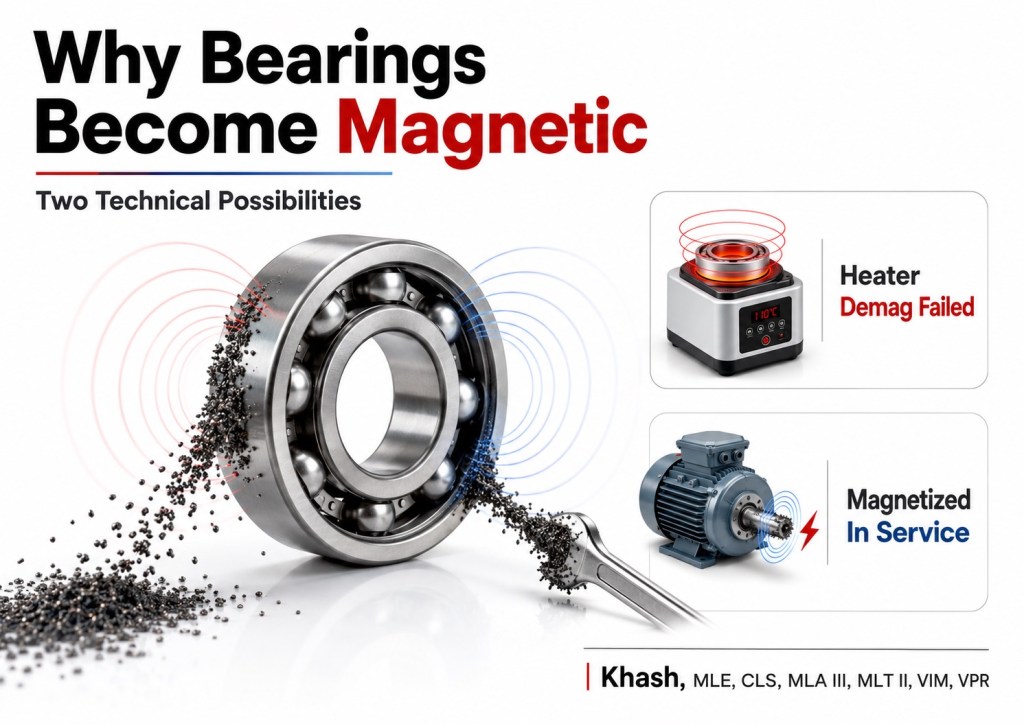
Khash has seen many failed bearings which are magnetized and attract ferrous particles. Wrote below to share results of many of my investigations in the field when this issue happened to me.
Why a Dismounted Rolling Bearing May Behave Like a Magnet: Two Technical Failure Hypotheses
A rolling bearing that attracts ferrous swarf, filings, a feeler gauge, or even a screwdriver after dismounting is showing residual magnetism, also called remanence. This is not merely a curiosity. In high-reliability rotating equipment, residual magnetism can attract metallic particles into the raceway/rolling-element contacts, complicate cleaning, increase abrasive indentation, and, in some applications, contribute to electrical or eddy-current damage mechanisms. Bearing-industry demagnetization is common enough that Maurer Magnetic notes that rolling bodies, inner rings, and outer rings are normally demagnetized separately before assembly, and that residual magnetism limits are widely used as a quality criterion in bearing manufacture. (Maurer Magnetic)
There are two credible explanations for a bearing behaving like a magnet after removal:
- The bearing was magnetized during induction heating for mounting or dismounting, and the demagnetization step was ineffective.
- The bearing, shaft, or bearing system became magnetized while in service.
Both mechanisms are physically plausible, and they are not mutually exclusive.
1. Basic physics: why bearing steel can retain magnetism
Most rolling-bearing rings and rolling elements are made from ferromagnetic hardened steels. When such a steel is exposed to a magnetic field, its magnetic domains rotate and align. When the external field is removed, the domains do not necessarily return to a random state. The remaining field is the remanent magnetic field, and its magnitude depends on the steel’s coercivity, hardness, stress state, geometry, previous magnetic history, and the peak magnetizing field.
A useful way to view this is the B–H hysteresis loop. If the part is driven around a large hysteresis loop and the field is then abruptly removed, the part can be left at a non-zero remanent flux density. Proper demagnetization drives the material through successively smaller hysteresis loops until the net magnetic state approaches zero. If the field is simply switched off at the wrong point, or if the demagnetizing field does not penetrate the relevant bearing components, a significant residual field may remain.
The units are often confused in maintenance reports. Practical bearing measurements are commonly reported in gauss or millitesla:
- 1 gauss = 0.1 mT = 100 µT
- In air, 1 gauss corresponds to about 79.6 A/m magnetic field strength.
A bearing does not need to become a “strong” magnet to create problems. Cestriom notes that ferromagnetic particles can adhere at residual magnetism levels above roughly 4–6 gauss, depending on particle properties, and that particles below about 200 µm may still be a concern even below that range. (cestriom.com)
Possibility 1: Induction heater magnetized the bearing, and demagnetization did not work
1.1 How induction heating magnetizes bearing rings
Induction heaters for bearing mounting/dismounting use an alternating magnetic field to induce current in the bearing ring. The induced current produces heat by electrical resistance, allowing thermal expansion for mounting or rapid ring expansion for dismounting. Schaeffler describes induction heating as an alternating-current coil generating a magnetic alternating field; when a bearing ring is introduced, a current is induced in the ring and heats it. Schaeffler explicitly states that bearing rings become magnetic during induction heating and that the required demagnetization is carried out using the same induction coil. (schaeffler.com)
For mounting, bearings are usually heated only to a moderate temperature. Schaeffler gives a typical temperature differential of +80 °C to +120 °C, and states that the bearing temperature must not exceed +120 °C. (schaeffler.com) That is important because these temperatures are far below the Curie temperature of bearing steel; mounting heat does not thermally erase magnetism. The demagnetization must be electromagnetic, not merely thermal.
1.2 How proper demagnetization should work
A proper demagnetization cycle applies an alternating magnetic field with a gradually decreasing effective amplitude. In some systems this is achieved electronically; in older or simpler procedures it is achieved by energizing the coil and physically withdrawing the coil or the component from the magnetic field. Schaeffler’s guidance for induction-heated bearing rings says residual magnetism remains to a greater or lesser degree, reused parts—especially rolling-bearing rings—must be demagnetized, and the coil may need to be withdrawn while energized until a distance of 1–2 m is reached; a second demagnetization pass may be necessary. (schaeffler.com)
The key word is effective. A demagnetization cycle that appears to run on the heater panel may not actually demagnetize the surfaces that matter: raceways, rolling elements, shoulders, end faces, and contact zones.
1.3 Failure modes of induction-heater demagnetization
Several technical failures can leave a bearing magnetized after induction heating.
Demagnetization cycle omitted or interrupted
Some bearing heaters have automatic demagnetization; others require a manual step. A power interruption, emergency stop, premature removal of the ring, or operator bypass can leave the bearing with whatever remanent state existed at switch-off.
Incorrect coil, yoke, ledge, or magnetic circuit
Induction heaters rely on coupling between the heater, yoke, and workpiece. Poor seating of the yoke, wrong crossbar size, a bearing placed off-axis, excessive air gaps, or use of a heater outside its intended bearing-size range can create uneven heating and uneven magnetization. The demagnetizing field may be strong at one face of the ring but insufficient at the raceway or rolling elements.
Residual field trapped in a closed ring geometry
A bearing ring is a convenient magnetic circuit. Because it is a closed, high-permeability path, it can support circumferential or axial remanent flux patterns. Pole concentrations can appear at ring faces, shoulders, slots, cracks, grinding marks, or local changes in section.
Demagnetization field too weak for the mass and section thickness
Large bearing rings, thick rings, and assembled bearings are more difficult to demagnetize than small loose rings. Electromagnetic penetration depends on frequency, permeability, conductivity, geometry, and local saturation. Maurer Magnetic notes that conventional demagnetization systems, including pass-through coils and surface demagnetizers, may fail to demagnetize the interior of assembled bearings because of low field strength and high demagnetizing frequency; the outer ring can shield internal bearing components from the effective alternating field. (Maurer Magnetic)
Assembled-bearing shielding
If a complete bearing was heated and demagnetized as an assembly, the outer ring can mask the magnetic condition of the rollers or balls. Maurer’s application note reports cases where exterior surfaces can appear acceptable while the rolling elements and running surfaces retain high magnetism; it also notes measured rolling-body residual magnetism up to 60 gauss in assembled bearings. (Maurer Magnetic)
This is especially important in failure analysis: a bearing can look “acceptable” if only the OD or side face is checked, while the rolling elements remain strongly magnetized.
Insufficient withdrawal distance or too rapid withdrawal
In withdrawal-type demagnetization, the operator must move the coil or part slowly enough and far enough that the field decays smoothly. Stopping too close, moving too fast, or switching off before the field amplitude has decayed can leave the part on a minor hysteresis loop with significant remanence.
Re-magnetization after a successful demag cycle
A bearing may be demagnetized correctly and then re-magnetized by a magnetized shaft journal, housing bore, lifting magnet, magnetic base, magnetized drift, magnetic crack-test equipment, magnetic chuck, or another magnetized bearing. Maurer specifically warns that tools and components in contact with bearings should be checked for residual magnetism and demagnetized if needed. (Maurer Magnetic)
1.4 Damage mechanisms if the bearing is installed magnetized
A magnetized bearing can attract ferromagnetic debris from the workplace, from the housing, from wear particles already in the lubricant, or from grinding/assembly residue. The particles can become trapped in the rolling contact and produce indentations. Maurer summarizes this mechanism directly: magnetic adhesive force is proportional to approximately the square of the magnetic field strength, and residual dirt/particles can dent running surfaces, causing vibration and wear. (Maurer Magnetic)
Magnetism also complicates lubricant cleanliness. A bearing that has been washed can still retain particles if those particles are magnetically adhered to rolling elements, cage pockets, raceway shoulders, or ring faces. Bussi’s bearing-industry guidance identifies magnetic chucks, grinding, crack analysis, induction machines, assembly machines, and laser markers as causes of magnetization, and states that poor demagnetization can lead to friction, noise, early wear, and reduced life. (bussi-demagnetizers.com)
1.5 Evidence supporting the induction-heater hypothesis
The induction-heater explanation becomes strong when the evidence looks like this:
- The bearing was heated by induction shortly before installation or removal.
- The bearing showed magnetism immediately after mounting, before meaningful service time.
- Other bearings mounted with the same heater show similar residual magnetism.
- The magnetic field is strongest on the ring heated directly by the coil.
- There is no convincing evidence of electrical erosion, fluting, arc pitting, blackened grease, or shaft-current history.
- The shaft and housing are not magnetized, or are much less magnetized than the bearing.
- Repeating the heater/demag process on a scrap ring reproduces the condition.
For a dismounted inner ring from a cylindrical roller bearing, this is often the first hypothesis to test, because the induction heater directly couples to the ring and Schaeffler’s own literature states that bearing rings become magnetic during induction heating. (schaeffler.com)
Possibility 2: The bearing was magnetized in service
2.1 This is possible, but the mechanism matters
A rolling bearing does not normally become a strong magnet simply because it rotates under load. Ordinary rolling contact, lubrication shear, and Hertzian stress are not usually sufficient to magnetize a bearing to the point that it attracts tools or metal swarf. However, a bearing can become magnetized in service if it is exposed to one or more of the following:
- Significant DC or pulsed current through the shaft/bearing system.
- Strong stray magnetic fields from electrical machines or nearby magnetic equipment.
- A magnetized shaft, rotor, housing, coupling, or maintenance tool.
- Welding current or fault current passing through the shaft/bearing.
- Lightning or high-energy electrical transient.
- Magnetic particle inspection or other magnetic NDT performed during maintenance and not properly demagnetized afterward.
EASA states that motor shafts can become magnetized in service from electric current through the motor and shaft, welding, variable-frequency drives, system faults, or lightning; it also notes that a magnetized shaft may be strong enough for a screwdriver to stick and can attract metal bits to bearings. (EASA)
2.2 Magnetization by current through the bearing or shaft
A current flowing through a conductor produces a magnetic field:
[
H = \frac{I}{2\pi r}
]
where (H) is magnetic field strength, (I) is current, and (r) is radial distance from the current path. A 200 A welding return current flowing through or near a 50 mm diameter shaft gives an air-equivalent circumferential field on the order of tens of gauss. A fault current or lightning transient can be much higher. If that field is applied to hardened bearing steel, especially with a DC or unidirectional pulse component, it can leave remanent magnetization.
This is different from ordinary high-frequency bearing currents in a VFD motor. VFD-related currents often produce electrical erosion more than simple bulk magnetization. SKF identifies common sources of stray electric currents as motor magnetic-circuit asymmetry, unshielded power cables, and fast-switching PWM frequency converters used in VFDs; SKF also states that current passage through a bearing can cause micro-cratering, local melting, raceway washboard patterns, lubricant degradation, noise, heat, vibration, and reduced service life. (SKF)
Schaeffler similarly states that current passage in rolling bearings can damage raceways and rolling elements and degrade the lubricant, leading to premature and unexpected motor or generator failure. (Schaeffler) It describes typical current-passage damage as matt grey marks, fluting, melt craters, and welding beads in the micrometre range. (Schaeffler)
The critical distinction is this: electrical erosion proves current passage, but not necessarily residual magnetism; residual magnetism proves magnetic exposure, but not necessarily damaging current passage. In many real machines, both are present.
2.3 VFD motors, generators, traction motors, and wind turbines
In electric machines, shaft voltage and bearing currents can occur because of:
- Common-mode voltage from PWM drives.
- Capacitive coupling between stator, rotor, and frame.
- Magnetic asymmetry in the motor.
- Poor high-frequency grounding.
- Rotor ground currents.
- Circulating currents in large machines.
- Inadequate cable shielding or grounding.
- Insulated coupling or grounding-brush failure.
Schaeffler lists wheelsets, gearboxes, traction motors, AC/DC motors, and wind generators as application areas where current passage can occur in rolling bearings. (Schaeffler) In these machines, a dismounted bearing that is magnetized should always trigger an electrical investigation, not merely a demagnetization exercise.
Typical supporting symptoms include:
- Grey, frosted, or matt raceways.
- Axial fluting or “washboarding” on raceways.
- Microcraters under magnification.
- Blackened or degraded grease.
- Increased vibration at bearing defect frequencies and broadband high-frequency content.
- Repeated bearing failures on the same motor position.
- Shaft voltage measurable with a shaft-riding brush and oscilloscope.
- A magnetized shaft or housing even after the bearing is removed.
2.4 Welding current through the machine
Welding is a particularly credible in-service or maintenance-related magnetization mechanism. If the welding return clamp is placed so that current passes through the shaft, bearing, coupling, gearbox, or housing, the bearing may experience both magnetic exposure and arc damage. The current does not need to pass uniformly through the whole bearing; intermittent rolling contacts can create localized arcs and localized residual fields.
A welding-related bearing event may show:
- Localized arc pits rather than uniform fluting.
- Burn marks on one or a few rolling elements.
- Darkened grease near the current path.
- Magnetic poles concentrated near one angular sector.
- Magnetized shaft/housing along the welding return path.
- Similar damage in adjacent bearings or couplings.
2.5 Magnetization transferred from shaft, housing, or adjacent equipment
Sometimes the bearing appears to have become magnetized “in use,” but the root cause is that it was installed onto a magnetized shaft or into a magnetized housing. The bearing then partially inherits the magnetic state by contact and by sharing the magnetic circuit.
This can happen after:
- Shaft straightening or repair using magnetic fixtures.
- Magnetic particle inspection without adequate demagnetization.
- Magnetic chucking during grinding.
- Contact with magnetic lifting equipment.
- Proximity to electromagnetic brakes, magnetic couplings, separators, or permanent magnets.
- Previous bearing failures that left magnetized debris or components in the assembly.
In this case, demagnetizing only the bearing is insufficient. The shaft, housing, spacers, sleeves, locknuts, labyrinth rings, seals, and tools must also be surveyed.
2.6 Mechanically induced magnetism: possible but usually secondary
Rolling contact stress can affect magnetic domain structure through magnetoelastic effects. In bearing steels, stress and microstructural changes are measurable by magnetic methods such as Barkhausen noise. However, pure rolling contact is usually not the primary explanation for a bearing that visibly attracts steel objects. Mechanical stress can redistribute or reveal an existing magnetic state, but a strong residual field normally implies a stronger external magnetic or electrical cause.
How to distinguish the two hypotheses
3.1 Compare the bearing, shaft, housing, and tooling
A proper investigation should not measure only the removed bearing. Measure:
- Inner ring bore, faces, shoulders, and raceway.
- Outer ring OD, faces, and raceway.
- Rolling elements, rotating them during measurement if possible.
- Steel cage, if applicable.
- Shaft journal, shoulder, keyway, threads, locknut, sleeve, spacer, and labyrinth ring.
- Housing bore, cap, seals, and adjacent ferromagnetic components.
- Lifting equipment, pullers, induction-heater yokes, magnetic bases, and assembly tools.
Maurer notes that rolling bodies and running surfaces can be difficult or impossible to access with a probe in assembled bearings, and that the exterior residual magnetism may be acceptable while the internal magnetic state remains unknown. (Maurer Magnetic) For a critical investigation, an assembled bearing may need partial disassembly or a sacrificial sample.
3.2 Look for electrical damage
The in-service current hypothesis becomes much stronger if the bearing also shows current-passage damage. According to Schaeffler, current-passage damage can include matt grey raceway marks, fluting, melt craters, welding beads, and lubricant degradation. (Schaeffler) SKF’s glossary defines electrical erosion as macro- or microcraters caused by local melting when damaging current passes through rolling contacts, and it describes fluting as repetitive, closely spaced transverse wear often formed by microcraters from electric current passage.
Recommended inspections:
- Low-power stereomicroscope for fluting, pitting, and arc tracks.
- SEM if electrical erosion must be confirmed.
- Grease analysis for iron concentration, oxidation, and blackening.
- Vibration-history review for high-frequency bearing energy and rising noise.
- Shaft-voltage measurement during operation.
- Grounding and bonding audit.
- VFD cable shielding and common-mode mitigation review.
3.3 Examine the magnetic field pattern
Field distribution can be diagnostic.
Induction-heater origin often shows:
- Strong remanence on the ring heated directly.
- More circumferentially uniform or face-to-face polarity patterns.
- Similar magnetization on multiple bearings processed with the same heater.
- High field immediately after heating.
- No corresponding shaft/housing magnetization.
In-service origin often shows:
- Shaft, coupling, housing, or adjacent components also magnetized.
- Localized poles near current paths, shoulders, keyways, or contact zones.
- Bearing damage consistent with electrical discharge.
- Repeated failures in the same machine location.
- Correlation with VFD operation, welding, grounding faults, lightning, or motor repairs.
3.4 Recreate the suspected induction process on a scrap ring
A very practical test is to run a scrap bearing ring or rejected bearing through the same induction heater with the same setup, time, temperature, yoke, and operator procedure. Measure residual magnetism before heating, after heating, after demagnetization, and after handling with the normal tools.
If the test ring exits the process magnetized, the heater/procedure is suspect. If it exits clean but the machine components are magnetized, the in-service hypothesis becomes stronger.
Measurement procedure for residual magnetism in bearings
A rigorous measurement method is essential. A smartphone magnetometer or compass can indicate that something is wrong, but it is not suitable for acceptance testing.
Use a calibrated DC gaussmeter/teslameter with an axial or transverse Hall probe. Zero the instrument away from steel structures, preferably in a zero-gauss chamber or a manufacturer-approved zeroing fixture. Keep the probe normal to the surface being measured unless the procedure specifies otherwise. Document both polarity and magnitude.
Recommended scan points:
- Inner ring bore at 0°, 90°, 180°, 270°.
- Inner ring side faces and shoulders.
- Inner ring raceway, if accessible.
- Outer ring OD and faces.
- Outer ring raceway, if accessible.
- Rolling elements; rotate each accessible roller or ball while scanning.
- Cage pockets if the cage is ferromagnetic.
- Shaft journal and shoulder.
- Housing bore.
- Any spacer, sleeve, locknut, seal wear ring, or labyrinth ring.
Record the maximum absolute value, not only an average. A bearing with most surfaces at 1–2 gauss but a local 25 gauss spot on a roller is not magnetically clean.
Practical acceptance levels
There is no single universal residual-magnetism limit for all bearings and all industries. Limits depend on bearing size, cleanliness requirements, lubricant filtration, speed, load, application criticality, and customer specification.
However, practical guidance is available:
- Maurer reports high-performance demagnetization achieving below 5 gauss on fully assembled bearings. (Maurer Magnetic)
- Cestriom notes particle-adherence risk above roughly 4–6 gauss for ferromagnetic contamination. (cestriom.com)
- Bussi states that bearing-component residual magnetism requirements are often in the range of 2–12 A/cm, approximately 2.5–15 gauss, depending on component size. (bussi-demagnetizers.com)
- In turbomachinery practice, Nippes proposed 3 gauss or lower for bearings, seals, journals, collars, gears, and other oil-film surfaces, with higher limits for less critical components.
For high-speed, high-cleanliness, electrically sensitive, or critical rotating equipment, I would treat ≤2–3 gauss at rolling-contact-related surfaces as a conservative target, ≤5 gauss as a common industrial control target, and anything above 10 gauss as requiring engineering review unless the OEM specification explicitly permits it.
Corrective actions
4.1 If induction-heater demagnetization is the likely source
The corrective actions are procedural and equipment-based:
- Verify the heater’s demagnetization function with a calibrated gaussmeter.
- Confirm the correct yoke, ledge, coil, and bearing orientation.
- Measure every critical bearing after heating and before installation.
- Add a second demagnetization pass for large rings or stubborn components.
- Use a low-frequency, high-energy demagnetizer for large rings or assembled bearings when the heater’s built-in demag is inadequate.
- Demagnetize bearing components separately where possible.
- Demagnetize shafts, sleeves, housings, and tools before assembly.
- Avoid magnetic lifting, magnetic bases, and magnetized workholding near clean bearings.
- Add a magnetic-cleanliness hold point to the mounting procedure.
For a bearing that has already been run while magnetized, demagnetization alone may not be enough. Inspect for particle indentation, abrasive wear, and lubricant contamination. If raceways or rolling elements are indented or fluted, the bearing should normally be rejected rather than simply demagnetized.
4.2 If in-service magnetization is likely
The corrective actions depend on the source:
- For VFD motors: review cable shielding, grounding, common-mode filtering, shaft grounding, insulated bearings, hybrid ceramic rolling elements, and insulated couplings.
- For large motors/generators: investigate circulating currents, rotor ground currents, magnetic asymmetry, bearing insulation strategy, and grounding brush performance.
- For welding: prohibit welding return paths through shafts, bearings, couplings, gearboxes, or housings; place the return clamp directly on the welded component.
- For lightning/fault events: inspect all current paths, not only the failed bearing.
- For magnetized machine parts: demagnetize shaft, housing, spacers, sleeves, seals, and tooling before installing a new bearing.
- For magnetic NDT: require post-test demagnetization and documented residual-field measurements.
Schaeffler notes that conductive elements, improved grounding, and bearing insulation are established remedial measures for unwanted bearing currents in electric motors. (Schaeffler) SKF similarly presents hybrid and electrically insulated bearings as solutions for stray-current bearing damage. (SKF)
Final assessment
The induction-heater hypothesis is highly credible whenever the bearing or ring was heated for mounting or dismounting and no verified residual-field measurement was taken afterward. Induction heating is known to magnetize bearing rings, and demagnetization can fail if the procedure, geometry, field strength, frequency, or operator technique is unsuitable.
The in-service magnetization hypothesis is also credible, especially in motors, generators, traction drives, wind turbines, VFD-driven machines, welded equipment, or machinery with known grounding/fault-current problems. In that case, look for corroborating evidence: magnetized shaft/housing, electrical erosion, fluting, microcraters, blackened grease, repeated failures, or a history of welding/current events.
The most defensible conclusion is not to choose one explanation by assumption. Treat the bearing as evidence. Measure the bearing, shaft, housing, tools, and heater process. If the field is confined mainly to the induction-heated ring and reproducible with the heater, the mounting/dismounting process is the likely cause. If the machine components are also magnetized or the bearing shows electrical erosion, the bearing was probably magnetized or electrically damaged in service.

