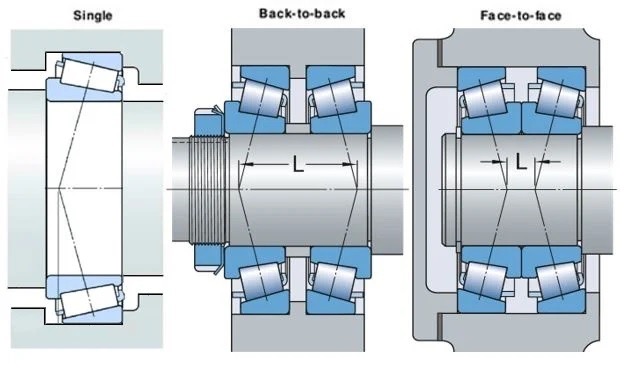
All three—the housing-cover shim, the locknut adjustment and the inner-ring spacer—control the axial setting of the tapered roller bearing pair. That setting determines whether the assembly has endplay, approximately zero clearance, or preload. It directly affects shaft positioning, stiffness, friction, temperature and bearing life. NSK Global
The critical distinction is whether the nut is moving an adjustable inner ring or clamping the rings against a solid spacer.
1. Housing-cover shim thickness: face-to-face arrangement
Assuming the shim is between the cover flange and the housing face, and the cover’s internal projection locates the outer ring:
| Change | Mechanical effect | Effect on bearing setting |
|---|---|---|
| Increase shim thickness | Holds the cover farther away from the housing, allowing the adjustable outer ring farther outward | More endplay / less preload |
| Decrease shim thickness | Allows the cover to move farther inward and push the outer ring inward | Less endplay / more preload |
This agrees with Timken’s adjustment method: the required cover shim pack incorporates the measured cover-to-housing gap plus the desired endplay. timken.com
The shim therefore forms part of the bearing’s precision dimensional setting.
Illustrative example: Suppose a particular assembly has 0.08 mm axial endplay, and the required value is 0.03 mm. In a rigid, fully seated arrangement with this direct adjustment, reducing the cover-flange shim pack by approximately 0.05 mm would remove that difference. The final endplay still needs measurement after tightening.
The shim location matters. If it sits inside the housing, between the cover’s pushing face and the outer ring, increasing its thickness pushes the ring farther inward—the effect reverses. That follows from the geometry; “a thicker shim increases clearance” is valid only after identifying its position.
2. Locknut tightening: back-to-back arrangement
A. When there is no solid spacer stopping inner-ring movement
Advancing the adjusting nut moves one inner ring toward the other. It progressively removes endplay, reaches zero clearance and then creates preload. The adjustment must be checked using the specified bearing-setting measurement. timken.com
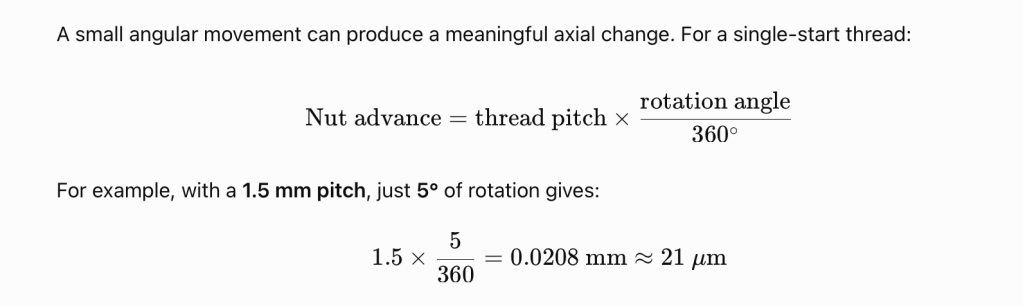
That is the nut’s geometric advance. How much becomes bearing displacement depends on seating, fits and elastic deformation.
B. When a solid inner-ring spacer is present
Once the inner rings, spacer and shaft shoulder are fully seated, the nut clamps that stack together. The effective spacer length and the remaining assembly dimensions largely establish the bearing setting. Timken describes preset assemblies as requiring proper clamping through their spacers. timken.com
Consequently, a correctly tightened nut can coexist with either excessive endplay or excessive preload if the spacer dimensions are wrong.
However, torque still matters. An excessive clamping force can compress or distort the spacer and change the setting. NSK specifically identifies spacer deformation under excessive locknut torque as a cause of unexpectedly high preload in position-preloaded bearing assemblies. nsk.com
Locknut tightening torque and bearing rotational torque are different measurements:
| Measurement | What it measures |
|---|---|
| Locknut tightening torque | Resistance while turning the nut on its thread; affected by thread and seating-face friction |
| Bearing rotational torque | Resistance while rotating the assembled shaft or housing; can indicate preload when measured using a validated procedure |
NSK’s tightening calculations explicitly include friction at the threads and nut seating surface. Timken’s rolling-torque method requires controlled lubricant and rotational speed, with seal and other component drag accounted for. nsk.com
A collapsible or crush spacer is a separate case: tightening deliberately changes its length, so the solid-spacer explanation cannot be applied unchanged.
3. Inner-ring spacer tolerance: back-to-back arrangement
With the outer-ring positions fixed and all parts seated:
| Inner spacer condition | Effect |
|---|---|
| Longer than required | Holds the inner rings farther apart: more endplay / less preload |
| Shorter than required | Allows the inner rings closer together: less endplay / more preload |
Timken’s cone-spacer calculation confirms this relationship: add the desired endplay to the zero-setting spacer dimension, or subtract the desired dimensional preload. timken.com
Why small dimensional errors matter
For illustration, suppose the spacer length corresponding to zero setting is 40.000 mm:
| Effective spacer length | Idealized geometric result |
|---|---|
| 40.030 mm | Approximately 0.030 mm endplay |
| 40.000 mm | Approximately zero setting |
| 39.980 mm | Approximately 0.020 mm dimensional preload |
These are explanatory numbers, not recommended settings. They assume unchanged bearing standouts, fixed outer-ring positions and negligible changes in clamp deformation.
Also, 0.020 mm dimensional preload does not specify a preload force. Converting displacement into force requires the bearing and assembly stiffness; preload may be expressed as either force or displacement. skf.com
Length is only part of spacer quality
The spacer’s faces must also have suitable flatness and parallelism. A spacer can have the correct average length yet tilt a ring if its faces are not parallel. NSK identifies excessive spacer parallelism error as a cause of bearing tilt, running inaccuracies and noise. nsk.com
The engineering consequence is that spacer inspection should include face geometry and seating condition, alongside length. Measuring only one point with a micrometer does not establish that the spacer will support the ring correctly.
The complete setting also depends on the bearing dimensions and shaft/housing fits. Therefore, replacing bearings does not automatically preserve the setting obtained with an existing spacer; factory-matched spacers must remain with their intended bearing assembly. timken.com
4. How these settings affect actual bearing performance
Excessive endplay
The rollers have greater freedom to move outside the loaded region. Timken associates excessive endplay with roller unseating, skidding and skewing, followed by raceway scalloping and cage-pocket wear. timken.com
At machine level, the extra freedom also allows more shaft movement before the bearing pair fully resists a reversing load. In a gearbox, for example, that movement can change the gear contact conditions. Where accurate positioning is required, inadequate preload can leave insufficient stiffness and poorer control of shaft runout. NSK Global
Correct application-specific setting
A suitable setting provides the required shaft guidance and stiffness while keeping internal loading and friction acceptable. Controlled preload can reduce deflection and gear-mesh variation, but its value must suit the application. skf.com
Excessive preload
Preload creates internal contact loads before the external working load is applied. Too much increases frictional resistance and heat generation and reduces fatigue life. NSK Global
There are two distinct routes to damage:
- Thermal and lubrication distress: excessive contact loading and friction generate heat and can compromise lubrication.
- Contact fatigue: even when the lubricant prevents immediate scoring, the additional loading can still cause premature subsurface fatigue and spalling. Timken explicitly describes this second mechanism. timken.com
Thus, changing to a stronger EP lubricant does not correct an incorrectly preloaded assembly.
5. The setting must be correct at operating temperature
The cold assembly setting can differ substantially from the running setting. Thermal expansion and component deflection change the relative positions of the rings. An application may therefore need cold endplay to reach its intended operating condition, while another may require deliberate cold preload. timken.com
For the conventional arrangements being discussed, when the shaft runs hotter than the housing:
- Radial expansion of the inner rings tends to increase preload.
- Relative axial expansion tends to increase preload in a face-to-face arrangement.
- In a back-to-back arrangement, axial expansion can reduce preload and partly oppose the radial effect.
The net result depends on bearing spacing, materials and the actual temperature distribution. A back-to-back pair is therefore not automatically immune to thermal preload changes. skf.com
6. What the “L” in your drawing means
The L shown is the effective distance between the bearing pressure centres.
For comparable bearing spacing, the back-to-back arrangement has a larger effective support span and greater resistance to tilting moments. The face-to-face arrangement is generally more accommodating of limited misalignment. SKF nevertheless notes that misalignment still increases noise and reduces bearing life. skf.com
This is a separate design choice from setting the clearance: correct shimming cannot give a face-to-face pair the same effective moment-support span as a back-to-back pair.
7. What I would require in the assembly procedure
For these arrangements, I would record:
- The specified cold endplay or preload, including the measurement method.
- The actual shim or spacer dimensions, with its precise location identified.
- The specified locknut and cover-bolt tightening requirements.
- The final measured setting after seating, tightening and locking.
- The operating temperature and vibration trend during the initial run.
For an endplay measurement, rotate or oscillate the assembly while seating it in each axial direction, then measure the shaft’s axial travel. For a preloaded assembly, use the specified rotational-torque, displacement or load-based method. A dial indicator showing no free endplay cannot tell you whether the preload is correct or excessive. timken.com
The assembly instruction should therefore specify both the fastening requirement and the bearing-setting acceptance criterion. “Tighten the nut” or “refit the original shims” leaves the performance-critical result unverified.

