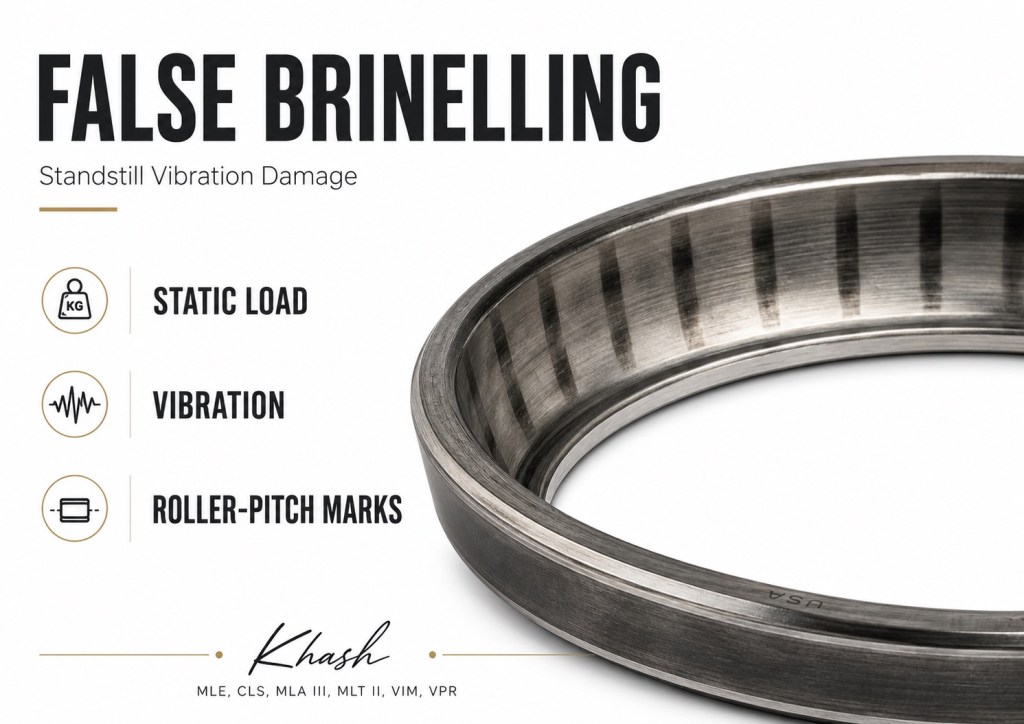
False Brinelling in Bearings
Practical guide for motor and electrical workshops
The bearing in your photos shows a classic warning sign: repeated dark vertical bands at roller spacing on the raceway. In a cylindrical roller bearing, that pattern is very often associated with false brinelling.
False brinelling is damage that happens when a bearing is not rotating normally, but is still exposed to vibration or small movement while loaded.
What false brinelling is
False brinelling is fretting damage at the rolling element contact points.
The bearing is standing still. The rollers or balls are pressed against the raceway by rotor weight, belt pull, shaft weight, or preload. Then vibration makes the rolling elements move microscopically back and forth in the same contact position.
The result is:
- lubricant is pushed away from the contact,
- metal surfaces rub microscopically,
- fine wear particles are produced,
- those particles oxidize,
- dark brown, black, grey, or polished marks appear at roller spacing.
It looks like brinelling, but it is not caused by one heavy shock load. That is why it is called false brinelling.
Typical appearance
In a cylindrical roller bearing, false brinelling usually appears as:
| Sign | What you see |
|---|---|
| Mark shape | Straight axial bands across the raceway |
| Spacing | Repeated at roller pitch |
| Colour | Brown, black, grey, or shiny |
| Depth | Shallow depressions or worn patches |
| Edges | Usually no raised lips |
| Location | Often in the loaded zone of the bearing |
Your photos show the important feature: many equally spaced roller-length marks. That is much more typical of false brinelling than random contamination scratches.
How it happens in a workshop
False brinelling commonly happens when a motor or machine is stored after bearing installation.
Common workshop situations:
| Situation | Why it causes damage |
|---|---|
| Motor stored near running machines | Floor vibration enters the stationary bearing |
| Motor transported with bearings installed | Road vibration makes rollers fret on raceways |
| Rotor not locked during transport | Shaft moves slightly inside the bearing |
| Standby motor left idle for months | Continuous plant vibration damages contact points |
| Belt left tensioned during storage | High static load increases contact pressure |
| Shaft only rocked a few degrees | Creates more fretting instead of proper lubrication |
| Motor stored in damp area | Fretting plus corrosion becomes worse |
A bearing does not need to be running to be damaged. It only needs static load + vibration + time.
Simple mechanism
Inside the bearing, each roller is sitting on the raceway. The contact area is very small, so the local pressure is high.
When vibration passes through the motor:
- The roller and raceway move microscopically.
- The grease film is squeezed out.
- Fresh lubricant is not replenished because the bearing is not rotating.
- Steel touches steel.
- Tiny particles are rubbed off.
- The particles oxidize and become dark.
- A shallow mark forms exactly where the roller was sitting.
After enough time, the raceway has repeated marks at roller spacing.
False brinelling vs true brinelling
This distinction is important.
| False brinelling | True brinelling |
|---|---|
| Caused by vibration/micromovement | Caused by heavy shock or overload |
| Happens during standstill or transport | Happens from impact, hammering, overload |
| Marks are worn/fretted | Marks are plastic dents |
| Often dark or oxidized | Often clean indentation marks |
| Usually no raised edges | May have raised lips around dents |
| Develops over time | Can happen instantly |
A simple rule:
True brinelling is a dent. False brinelling is a fretted wear mark.
False brinelling vs electrical fluting
In electric motors, do not confuse false brinelling with electrical damage.
| False brinelling | Electrical fluting |
|---|---|
| Marks at roller spacing | Many fine washboard grooves |
| Caused by vibration at standstill | Caused by current passing through bearing |
| Usually larger roller-shaped bands | Usually very fine parallel lines |
| Often brown/black fretting debris | Often grey, frosted, cratered surface |
| Related to storage/transport/standby | Related to VFD, grounding, shaft voltage |
Your photos look more like roller-pitch false brinelling than electrical fluting.
Practical inspection checklist
When you receive a bearing like this, check the following before cleaning it:
- Are the marks equally spaced?
- Do they match the number or spacing of rollers?
- Are the marks shallow and dark?
- Are there matching marks on the rollers?
- Are there raised lips around the marks?
- Raised lips suggest true brinelling or impact.
- Is there reddish-brown or black fretting debris?
- Was the motor transported after bearing installation?
- Was the motor stored near running machinery?
- Was the shaft locked during transport?
- Was the shaft periodically rotated properly?
Photograph the bearing before washing it. Cleaning can remove the fretting evidence.
Can the bearing be reused?
In most motor repair work, a bearing with clear false brinelling should be treated as damaged.
Do not reuse it if:
- the marks can be felt with a fingernail,
- the raceway is rough,
- the motor is critical,
- the bearing is large or expensive to access,
- the machine had noise or vibration,
- marks are present on both rollers and raceway,
- the damage covers a wide running track.
False brinelling marks become stress raisers. Once the bearing runs, rollers pass over the damaged spots repeatedly. This can cause noise, vibration, heat, and later spalling.
Prevention in the workshop
Use these rules for repaired motors and spare machines:
1. Store motors away from vibration
Do not store completed motors next to:
- test benches,
- compressors,
- pumps,
- fans,
- presses,
- crushers,
- generators,
- large running motors.
Even low vibration can damage a stationary bearing over time.
2. Lock the rotor during transport
For large motors, transport with proper rotor locking or shaft support. Road vibration can destroy a new bearing before the motor reaches site.
3. Rotate the shaft properly
Do not just rock the shaft a few degrees. That can make false brinelling worse.
Better practice:
- rotate the shaft several full revolutions,
- do it at scheduled intervals,
- stop at a different position each time,
- document it on a storage tag.
4. Remove unnecessary static load
Where possible:
- release belt tension during storage,
- avoid coupling side-load during transport,
- support heavy shafts correctly,
- follow OEM transport instructions.
5. Control moisture
False brinelling becomes worse when moisture is present. Keep motors dry and use space heaters where required.
6. Use correct grease
Use the correct bearing grease, not just any available grease. For standby or storage conditions, grease should have good corrosion protection and anti-wear performance.
Practical workshop statement
A good report wording would be:
The bearing raceway shows repeated axial marks at roller spacing. The marks are consistent with false brinelling, caused by vibration or small oscillatory movement while the bearing was stationary under load. The damage likely occurred during storage, transport, or standby condition rather than normal running. The bearing should not be reused if the marks are tactile, rough, or associated with noise/vibration.
Main takeaway
False brinelling is damage from a bearing that was standing still but vibrating.
For cylindrical roller bearings, the classic sign is exactly what your photos show:
straight, repeated roller-shaped bands at equal spacing on the raceway.

