Mirror-like rolling bearing raceways: why it happens, why it is dangerous, and how to stop it
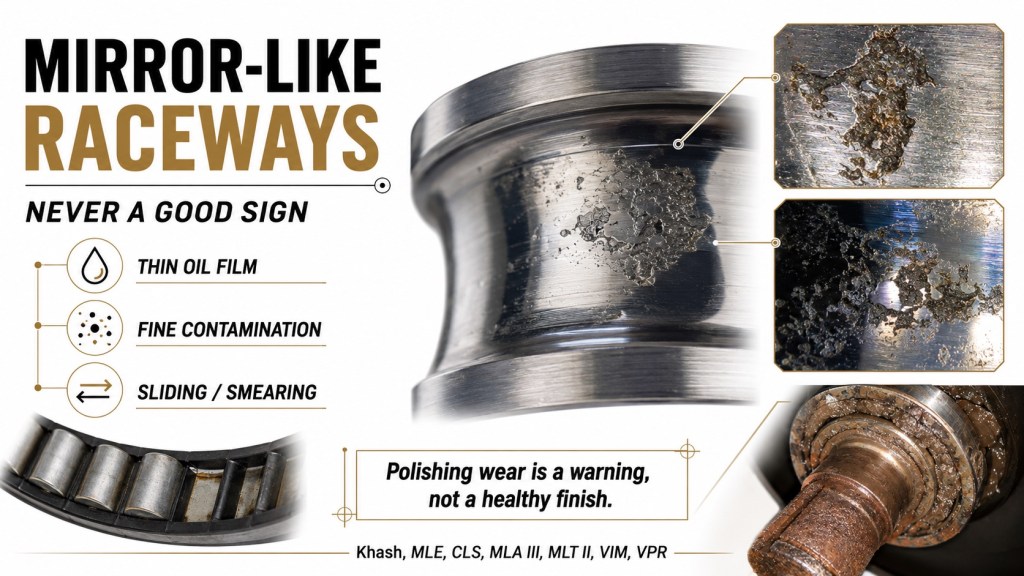
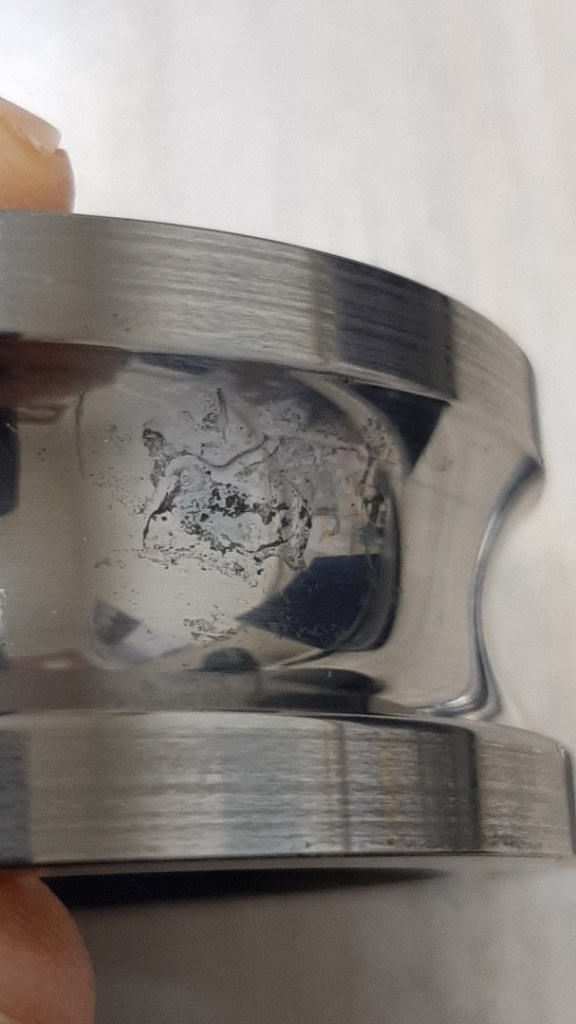
A rolling bearing raceway can be smooth and shiny from manufacturing, but it should not become a true mirror-like, lapped, chrome-looking track after service, especially when it is accompanied by black/brown lubricant, pitting, rough patches, cage wear, discoloration, or metal debris. In bearing failure analysis, that “mirror” is usually not a sign of good finish. It is usually a sign of polishing wear, often combined with lubrication starvation, fine contamination, sliding/skidding, corrosion, and heat.
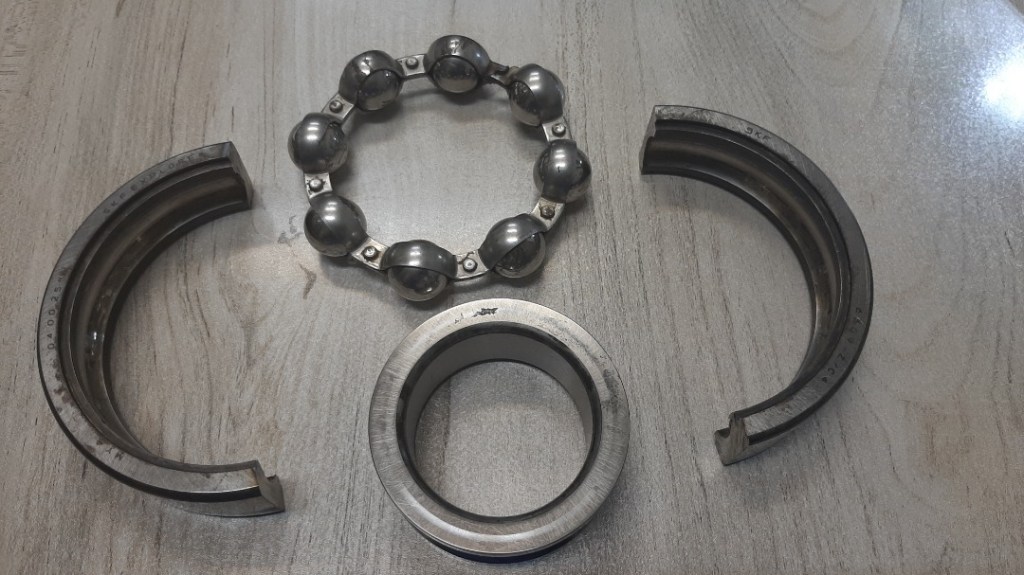
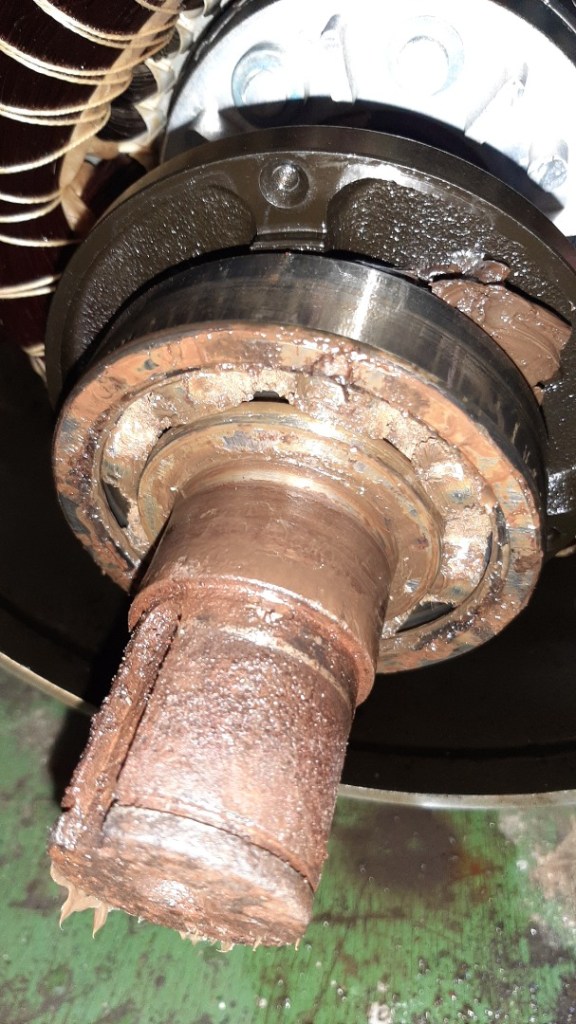
In the photos, the damage pattern looks severe: polished raceways, rough torn areas, dark contaminated lubricant, corrosion on the shaft area, and damaged rolling/cage components. From photos alone, the exact root cause cannot be certified, but the dominant failure chain is very likely:
contamination and/or water ingress → lubricant film collapse → abrasive polishing → metal-to-metal contact → smearing/pitting/spalling → heat, clearance change, cage damage, and final failure.
1. The key point: “shiny” is normal; “mirror-polished after service” is not
A new bearing raceway is manufactured by grinding and superfinishing. It may look bright and smooth, but it is not supposed to become a highly reflective mirror surface during operation. SKF specifically classifies polishing wear as a special form of abrasive wear and states that service-generated mirror-like surfaces result from a thin oil film and particles acting as a polishing agent.
That distinction is important:
Normal raceway appearance: uniform, smooth, controlled superfinish; possibly a light running track after operation.
Abnormal mirror raceway: extremely reflective, lapped-looking contact path, often with shape loss, edge wear, cage wear, dark lubricant, pitting, smearing, heat discoloration, or debris.
A mirror track means the bearing is no longer operating as a precision rolling contact. It has become a miniature grinding/lapping machine.
2. What should happen inside a healthy rolling bearing
In a healthy rolling bearing, the rolling element and raceway are separated by a very thin elastohydrodynamic lubrication film, often called EHL or EHD film. Under high Hertzian contact pressure, the lubricant viscosity increases locally and forms a load-carrying film between the steel surfaces. Timken explains that bearing life is directly linked to lubricant film thickness, which depends on viscosity, operating temperature, load, speed, and surface finish.
The film is extremely thin, often only fractions of a micrometre. That means the bearing is very sensitive to small changes. A slight drop in viscosity, a rise in temperature, too little lubricant supply, low speed, excessive load, poor surface finish, or contamination can move the contact from full-film lubrication into mixed or boundary lubrication.
A useful diagnostic concept is the lambda ratio, λ:

Timken describes lambda as the film thickness divided by the combined surface finish of the rolling element and raceway, and notes that a typical rolling bearing application may need around λ = 1.5 for surface separation, while λ below 1.0 can allow asperity contact.
When λ falls too low, the asperities — the microscopic peaks on the surfaces — touch. Once that happens, the bearing is no longer protected by fluid film. Wear begins.
3. The actual mechanism that creates the “mirror”
The mirror finish is mainly produced by fine abrasive polishing under poor lubrication.
Here is the sequence.
First, the lubricant film becomes too thin. This can happen because the grease or oil viscosity is too low at the actual operating temperature, the machine runs slowly under heavy load, the lubricant supply is starved, the grease has hardened or bled dry, the oil flow is low, or the bearing is overloaded. Timken lists improper viscosity, low lubricant flow, high load/low RPM, and high operating temperature as typical causes of inadequate lubrication.
Second, very fine particles enter or form inside the bearing. These particles may be dust, sand, rust, degraded grease residue, machining debris, seal wear particles, cage wear particles, or steel particles from early fatigue. Timken notes that even small foreign particles can disrupt the oil film and that fine material can lap the rolling elements and races.
Third, the particles pass through the loaded contact. Because the rolling element/raceway contact pressure is extremely high, the particles are crushed, embedded, dragged, or rolled through the contact zone. They remove asperity peaks and plastically flatten the surface. SKF describes this as a combination of inadequate lubrication, thin oil film, and fine particles acting as a polishing agent, allowing metal-to-metal contact and plastic deformation of asperities.
Fourth, the bearing becomes self-contaminating. Once wear starts, the bearing creates its own debris. The debris damages the lubricant, damaged lubricant carries more debris, and the raceway becomes progressively more polished. The surface may look beautiful, but the geometry is being destroyed.
That is why a mirror raceway is dangerous: the surface may look smoother, but the bearing is losing the controlled raceway profile that distributes stress correctly.
4. Why contamination and lubricant starvation usually appear together
People often ask: “Was it contamination, or was it poor lubrication?”
In many real failures, the answer is both.
Contamination makes lubrication worse because particles interrupt the film and create stress raisers. Poor lubrication makes contamination worse because metal-to-metal contact generates wear particles. Water makes both problems worse because it degrades grease/oil, promotes corrosion, and creates rust particles that become abrasives.
Timken identifies inadequate lubrication, contamination, overload, and improper handling/installation as four major bearing-damage drivers. It also lists overfilling, underfilling, incorrect lubricant specification, lubricant incompatibility, deteriorated lubricant, water contamination, and debris contamination as categories of inadequate lubrication.
This is why simply adding more grease after the raceway is already mirror-polished usually does not solve the problem. If the grease is contaminated, incompatible, overheated, or unable to form the correct film, adding more of the same problem only delays the next failure.
5. Adhesive wear and smearing: the second path to shiny damage
Not all shiny bearing damage is pure abrasive polishing. Another important mechanism is adhesive wear, often called smearing.
Adhesive wear happens when two metal surfaces slide relative to each other with insufficient lubrication. Microscopic junctions weld, tear, transfer metal, and generate local heat. SKF describes adhesive wear as damage between sliding surfaces, characterized by material transfer and often accompanied by frictional heat that can lead to cracking or spalling. Timken also associates adhesive wear with improper oil film, cage friction, and gross roller sliding.
This matters because rolling bearings do not experience pure rolling everywhere. There is always some microslip, and under bad conditions there can be gross sliding. Common causes include:
- too little load on roller bearings, causing rollers to skid instead of roll;
- rapid acceleration/deceleration;
- wrong internal clearance or preload;
- misalignment;
- cage instability;
- lubricant too thin or starved;
- high speed with poor oil supply;
- vibration or load reversals.
SKF notes that smearing can occur when rolling elements are suddenly accelerated as they enter the load zone after being retarded outside it. In practice, this is common in lightly loaded spherical roller bearings, cylindrical roller bearings, electric motors, fans, gearboxes, and pumps that run through unstable load/speed regions.
Adhesive wear often produces shiny patches, torn areas, streaking, dark discoloration, rough metal transfer, or heat marks. In your photos, the rough torn-looking zones on the polished surfaces are consistent with this kind of late-stage lubrication breakdown.
6. Water, corrosion, and rust: the hidden abrasive factory
The rusty shaft and brown/dark paste visible in the images are important clues. Water ingress or condensation can attack bearing steel and generate rust. Rust is abrasive. Once rust particles enter the rolling contact, they behave like lapping compound.
Timken states that water is particularly damaging to lubricant and that even small amounts can significantly affect bearing life. It also warns that moisture and water can cause corrosion/etching on raceways and rolling elements if not adequately protected.
Corrosion does not need to be dramatic to become destructive. Tiny etched pits become stress raisers. Under repeated rolling contact, those pits can initiate surface-origin fatigue. The first stage may be only discoloration or small specks. Later, the raceway becomes polished around the corrosion marks, then pitting, spalling, and cage damage appear.
So, in a failed bearing with a mirror raceway and rusty grease, the root cause is often not “the raceway polished itself.” The root cause is usually loss of lubricant integrity and cleanliness.
7. False brinelling and vibration polishing
Another related failure mode is false brinelling. This occurs when the bearing is stationary or oscillating with vibration. Because the bearing is not rotating enough to build a separating oil film, the rolling elements micromove against the raceway and wear small marks at rolling-element spacing. Schaeffler describes the cause as vibration in stationary machines causing micromotion between rolling elements and raceways, with no separating oil film when the bearing is not turning. (Schaeffler)
False brinelling usually does not create a full continuous mirror track. Instead, it creates regularly spaced elliptical or linear marks. But the wear debris it generates can later circulate during operation and contribute to polishing wear.
This is especially relevant for standby motors, pumps, gearboxes, fans, stored machines, transported equipment, and machines exposed to nearby vibration.
8. Electrical erosion: not the same as mirror polishing, but worth checking
If this is from an electric motor or VFD-driven equipment, check for electrical bearing damage too. Electrical erosion normally creates grey frosting, fluting, or crater-like damage rather than a pure mirror surface, but it can contaminate the grease and accelerate wear. Timken lists electric arc pitting, burns, and fluting as damage caused by improper grounding, welding damage, or static discharge.
For motor bearings, especially with variable frequency drives, the prevention strategy may need shaft grounding rings, insulated bearings, hybrid ceramic rolling elements, proper grounding, and correct drive filtering. Electrical damage and lubrication failure can coexist.
9. Why the mirror finish leads to catastrophic failure
A bearing raceway is not just a smooth circular groove. Its geometry is engineered: curvature, profile, surface finish, hardness, residual stress, and clearance all work together.
When polishing wear removes material, several things happen.
The raceway profile changes. The contact ellipse or line contact no longer sits where the designer intended. Load may concentrate at edges or in narrow bands.
Internal clearance increases or becomes uneven. The rolling elements no longer share load correctly. Cage motion becomes unstable.
The lubricant film gets even harder to maintain. A polished, worn track may have fewer oil-retaining valleys, while the changed geometry increases sliding and heat.
Wear debris increases. Metal and oxide particles circulate through the bearing, producing more abrasive wear.
Fatigue begins at the surface. Dents, pits, corrosion spots, and smeared areas become stress raisers. Timken notes that hard particles can bruise surfaces and create raised metal around dents, producing stress risers that reduce bearing life.
Eventually the bearing transitions from polishing to pitting, spalling, cage wear, overheating, seizure, or ring fracture. At that stage, the bearing is not recoverable.
How to avoid mirror-polished raceways
1. Select lubricant by operating condition, not by habit
The lubricant must be chosen for the actual bearing speed, load, temperature, orientation, sealing, duty cycle, and environment. “We always use this grease” is not an engineering specification.
Check:
- base oil viscosity at actual operating temperature;
- grease NLGI grade;
- thickener compatibility;
- oxidation stability;
- water resistance;
- EP/AW additive requirement;
- relubrication interval;
- oil flow or grease replenishment rate;
- high-temperature and low-temperature behavior.
Film thickness is strongly affected by speed and viscosity, while higher temperature reduces viscosity. Timken explains that EHD film thickness depends heavily on surface velocity and lubricant viscosity, and that when surfaces are not fully separated, asperity contact becomes vulnerable to surface fatigue.
For mirror polishing specifically, SKF recommends increasing lubricant viscosity and regularly monitoring lubricant cleanliness when the root cause is low viscosity plus fine abrasive particles.
2. Do not overgrease or undergrease
Under-greasing causes starvation. Over-greasing can cause churning, heat, seal damage, and grease breakdown. Both can lead to film failure.
Set the grease quantity and interval from bearing size, speed factor, housing type, temperature, and environment. Use measured grease quantities where possible, not “pump until it comes out.” For motor bearings, overgreasing is a common cause of heat and seal failure.
Timken identifies both overfilling and underfilling as lubrication problems and recommends specifying lubricant amount, type, grade, supply system, replenishment cycle, viscosity, and additives with the OEM or bearing supplier.
3. Control contamination as seriously as you control lubrication
A clean lubricant with the wrong viscosity is bad. The right lubricant full of dust, rust, and metal is also bad.
Control contamination at four points:
Storage: keep bearings sealed until installation; store grease/oil clean and sealed.
Assembly: clean housings, shafts, tools, grease guns, funnels, and hands; do not use dirty rags around open bearings.
Operation: maintain seals, breathers, shields, labyrinths, and filters.
Maintenance: sample oil/grease, check for water, particles, oxidation, viscosity change, and metal debris.
Timken emphasizes that seals are critical in guarding against contamination and recommends checking seal condition, leakage, and suitability for the operating environment. It also warns that high-pressure water, steam, or compressed air cleaning can damage seals and force contaminants into equipment.
4. Prevent water ingress and condensation
Water is one of the fastest ways to turn grease into destructive paste.
Check for:
- failed seals;
- pressure washing near bearing housings;
- condensation during shutdown;
- poor housing breathers;
- outdoor exposure;
- process fluid ingress;
- wrong grease for wet service;
- damaged shaft seal lands;
- blocked drain/vent paths.
For wet environments, use appropriate sealing, water-resistant grease, proper housing design, and regular purge/inspection practices. SKF’s damage-action guidance includes protecting the bearing arrangement, considering sealed bearings where the environment requires it, and ensuring adequate lubrication.
5. Avoid skidding: maintain correct load, clearance, and alignment
Roller bearings can be damaged by too little load as well as too much load. If the bearing is lightly loaded at speed, rollers may skid. Skidding creates sliding, heat, smearing, and polished raceways.
Check:
- minimum load requirement for the bearing type;
- correct internal clearance after mounting;
- thermal expansion effects;
- shaft and housing fits;
- preload/endplay;
- alignment;
- shaft/housing roundness;
- load direction and load zone;
- rapid acceleration cycles;
- cage design suitability.
SKF’s recommended actions for adhesive wear include making sure the bearing is adequately loaded, verifying lubricant selection, and considering coatings or hybrid bearings where appropriate. Timken also warns that incorrect clearance or preload can increase torque, stress, cage damage, and overheating.
6. Install the bearing correctly
A bearing can be destroyed before it ever runs.
Avoid:
- hammering through rolling elements;
- pressing on the wrong ring;
- dirty mounting tools;
- reused contaminated housings;
- burrs on shaft shoulders or housing seats;
- wrong fit;
- misalignment during assembly;
- mixing old and new damaged components;
- touching clean raceways with dirty gloves;
- leaving bearings open to dust.
Timken states that improper handling and installation can dent or nick highly engineered bearing components and undermine reliability, and recommends clean tools, clean environment, correct storage, and proper installation devices.
7. Monitor the bearing before the raceway reaches mirror condition
By the time you see a polished mirror track during teardown, the failure has already progressed. Prevention depends on catching the early signs:
- rising bearing temperature;
- increasing vibration;
- high-frequency bearing fault energy;
- abnormal noise;
- grease darkening;
- metallic particles in lubricant;
- lubricant leakage;
- water in grease/oil;
- frequent relubrication demand;
- seal wear;
- shaft current evidence in motors.
Timken lists vibration, abnormal noise, temperature increase, odd smells, lubricant deterioration, metal in lubricant, discoloration, leakage, and visual findings as warning signs of bearing deterioration.
Practical failure-analysis checklist for your shown bearing
For the bearing in your photos, I would treat the mirror raceway as a symptom, not the root cause. The investigation should ask:
- Was the lubricant correct?
Confirm grease/oil type, base oil viscosity, NLGI grade, additive package, compatibility, relubrication interval, and quantity. - Was the lubricant clean?
Look for metal, rust, sand/dust, process contamination, hardened grease, and water. - Did the seals fail?
Inspect shaft seal lands, lip hardness, groove wear, housing fit, breather condition, and signs of pressure-wash ingress. - Was there water or corrosion?
The rusty shaft area suggests this must be checked seriously. - Was the bearing overloaded, underloaded, or misaligned?
Look for edge loading, uneven raceway tracks, abnormal load zones, and cage pocket wear. - Was there skidding?
Check whether the bearing type had enough minimum load during high-speed or low-load operation. - Was there electrical current?
If this is from a motor, inspect for fluting/frosting and check grounding or VFD-related bearing current. - Was the housing/shaft fit correct?
Check for creep, fretting, out-of-roundness, incorrect interference, looseness, or excessive preload after mounting. - Was the bearing replaced without correcting the system?
If the same lubricant, seal, fit, alignment, or contamination source remains, the new bearing will usually fail the same way.
Final technical conclusion
A mirror-like rolling bearing raceway is usually produced when the bearing stops operating in a protected EHL regime and enters mixed or boundary lubrication. Fine particles then act like lapping compound, polishing the raceway while also removing material and changing the raceway geometry. Sliding and skidding can add adhesive wear and smearing. Water and corrosion generate abrasive rust particles. Heat lowers viscosity, which further reduces film thickness. The process becomes self-accelerating.
The fix is not to polish the raceway, add random grease, or simply replace the bearing. The fix is to restore the full bearing system:
correct lubricant viscosity + correct lubricant quantity + clean lubricant + effective sealing + correct fits/clearance/alignment + control of water, vibration, skidding, overload, and electrical current.
Once a raceway has reached the condition shown in the photos, the bearing should be considered failed. The valuable part is not the damaged bearing itself; it is the evidence it gives you about what must be corrected before the next bearing is installed.

