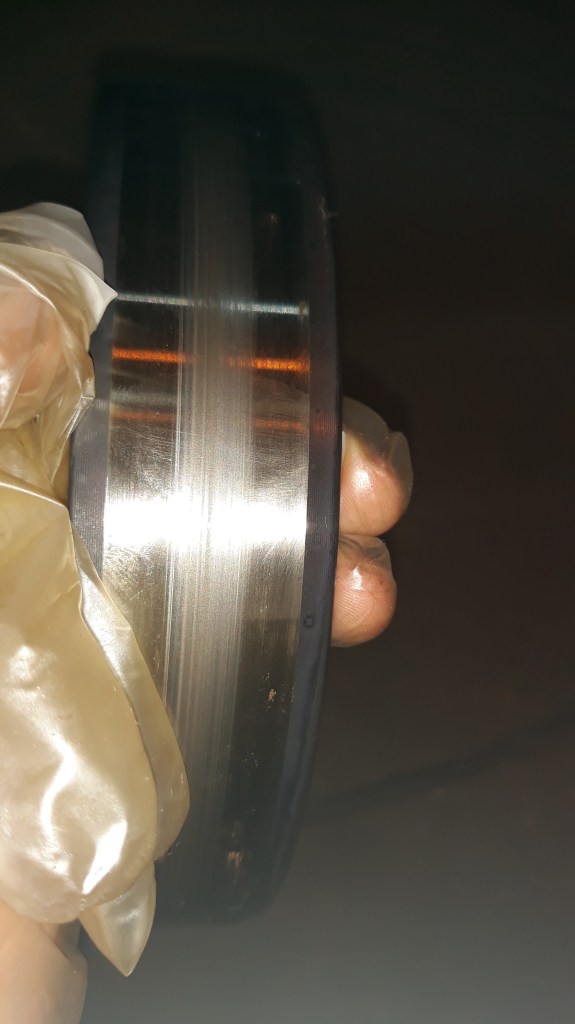
Smearing Damage in Cylindrical Roller Bearings During Uncoupled No‑Load Motor Test Runs
1. The workshop problem
A repaired electric motor is assembled with a new cylindrical roller bearing, usually on the drive end. The coupling, belt, pump, fan, gearbox, or driven machine is not connected. The motor is then run “free” on the test stand to check vibration, current, temperature, noise, and general operation. Within a short time the bearing starts to squeal, heat up, or become noisy. When dismantled, the rollers or raceways show shiny streaks, grey patches, scoring-like marks, or smeared metal.
This is not a mystery defect in the new bearing. It is often a test-run condition problem: a cylindrical roller bearing may need a minimum radial load to make the rollers truly roll instead of slide. EASA specifically warns that motors with roller bearings used in radial-load applications, such as belted drives, should not be run no-load for any length of time because the bearings can be damaged without that radial load.
2. What smearing actually is
In bearing failure terminology, smearing is a form of adhesive wear. It occurs when sliding happens under inadequate lubrication conditions and friction produces local temperature spikes. Microscopic high spots on the steel surfaces can momentarily weld, tear, and transfer material from one surface to the other. ISO 15243 describes smearing, also called skidding, galling, scoring, or frosting, as damage caused by sliding with localized frictional heating and material transfer. It also notes that this commonly occurs when rolling elements are too lightly loaded and are rapidly accelerated as they re-enter the load zone.
That last phrase is the key to your workshop situation: too lightly loaded + speed + acceleration = roller skidding risk.
3. Why cylindrical roller bearings are especially vulnerable
Cylindrical roller bearings are excellent for heavy radial loads and high-speed capability. That is why they are commonly used in medium and large electric motors, especially belt- or gear-driven machines where heavy radial loads are expected at the drive end. SKF describes N and NU cylindrical roller bearings as common in electric motors and generators, typically where belt or gear loads create significant radial load.
But that strength creates the test-stand weakness. A bearing selected for a belted, geared, or heavily radially loaded service may be too lightly loaded when the machine is uncoupled. Rotor weight alone may not provide enough load at the drive-end roller bearing. The result is a small, weak load zone, poor roller traction, unstable cage motion, and roller slip.
4. What happens inside the bearing during the no-load solo run
In ideal rolling, the roller surface speed matches the raceway surface speed. The roller rotates smoothly as it travels around the bearing. In a lightly loaded cylindrical roller bearing, that ideal condition may break down.
Here is the sequence:
The motor accelerates to test speed. The inner ring is driving the bearing kinematically, but the rollers are not sufficiently pressed into the raceways. In the unloaded zone, the rollers can slow down because they are influenced by cage drag, lubricant drag, and their own inertia. When those slowed rollers enter the load zone, they must suddenly accelerate to match raceway speed. If the speed difference is too large, they slide. That sliding produces local frictional heat. If the oil film or grease film cannot separate the surfaces, metal-to-metal contact occurs, creating smearing.
SKF’s bearing damage guide explains the same mechanism: outside the load zone, rolling element rotation can be retarded; when the rolling elements enter the load zone, sudden acceleration can cause sliding, heat generation, and material transfer.
5. Why the damage can start during a short workshop test
Smearing is not like normal fatigue, which usually takes many operating hours. It can be sudden. ISO 15243 explicitly describes smearing as usually sudden rather than a slow accumulated wear process.
That is why a brand-new bearing can leave the store clean, be mounted correctly enough to rotate, then be damaged during the first unloaded test. The bearing did not necessarily “fail because it was new.” It failed because the first running condition was outside what that bearing needed.
The fresh condition can make the risk worse. Fresh grease may not yet be distributed evenly. Too much grease can create churning drag. Cold grease can be stiff. SKF notes that if minimum load requirements are not met, skidding can occur, producing excessive heat and noise, and that very stiff greases can contribute to the problem, especially in cold environments.
6. The common workshop mistake: adding grease when it squeals
A skidding roller bearing may squeal. The natural reaction is to add grease. That may quiet the sound temporarily, but it does not remove the damage mechanism. EASA states that once the rollers skid and the bearing becomes noisy, damage has already occurred; adding grease only masks the damage, and the longer it runs without load, the worse it gets.
More grease can also increase drag and temperature during run-in, especially in high-speed motors. The correct response is not “add grease and keep running.” The correct response is stop, identify whether the bearing is below minimum radial load, and test with a controlled radial load.
7. How the damage appears
Typical smearing/skidding evidence may include:
| Location | Typical appearance |
|---|---|
| Outer ring raceway | Shiny or dull grey streaks in the rolling direction; local patches near load-zone entry |
| Inner ring raceway | Similar streaking or smeared patches |
| Roller outside diameter | Longitudinal streaks, scuffed areas, dull grey bands |
| Roller ends and guide ribs | Smearing, scoring, heat discoloration, metal transfer |
| Cage pockets | Polishing, rubbing, abnormal wear if roller motion became unstable |
ISO 15243 specifically illustrates smearing on the outer ring raceway and on the side faces of rollers in cylindrical roller bearings.
A key point: smearing is not just a scratch. It is adhesive damage. Under magnification, it often has torn, transferred, or roughened metal. A straight scratch from contamination or assembly handling may have sharp edges and one-direction scoring without heat-affected material transfer.
8. Why the uncoupled motor test is risky
A normal service center test is electrically useful but mechanically artificial. The motor is running, but the bearing system may not be loaded the way it is loaded in service.
For example, a motor designed for belt drive may use a cylindrical roller bearing on the drive end because the belt tension supplies radial load in service. Remove the belt, and the bearing sees only rotor weight and internal forces. That can be far below the minimum load needed to maintain stable rolling.
EASA’s recommendation is direct: the best way to test-run a motor with a roller bearing is to apply at least the minimum radial load, and the minimum depends on bearing type, size, and speed.
9. Minimum load: the practical calculation idea
The correct minimum load should come from the bearing manufacturer’s catalogue or application engineer. SKF’s electric motor bearing handbook states that ball and roller bearings must always be subjected to a minimum load, especially at high speeds, high accelerations, or rapid load changes; otherwise damaging sliding can occur between rolling elements and raceways.
For repair-shop practice, EASA gives this form for calculating minimum radial load on a roller bearing:Frm=kr×(6+nr4n)×(100dm)2
Where:dm=0.5(d+D)
And:
| Symbol | Meaning |
|---|---|
| Frm | minimum radial load, N |
| kr | bearing series minimum load factor |
| n | operating speed, rpm |
| nr | oil-lubrication speed rating from bearing tables |
| d | bearing bore, mm |
| D | bearing outside diameter, mm |
| dm | bearing mean diameter, mm |
EASA gives an example for a 315 roller bearing at 1800 rpm: the calculated minimum radial load is about 1615 N, equal to roughly 363 lb or 165 kgf.
Do not treat that formula as universal for every bearing brand and design. Use the bearing manufacturer’s catalogue value, especially for modern cage designs, special clearances, insulated bearings, hybrid bearings, high-speed machines, vertical machines, or VFD-driven motors.
10. Correct test-stand practice
A good workshop procedure for cylindrical roller bearing motors should be built around this rule:
Do not perform an extended uncoupled no-load run unless the roller bearing minimum radial load is satisfied.
A practical procedure:
- Identify the bearing arrangement: DE/NDE, bearing type, designation, clearance class, cage type, lubrication, and whether the cylindrical roller bearing is on the drive end.
- Determine the minimum radial load from the bearing manufacturer or an accepted calculation method.
- Apply a controlled radial load to the shaft during testing.
- Run only as long as needed to obtain electrical, vibration, speed, and temperature data.
- Monitor sound closely. A squeal from a roller bearing during no-load running is a warning sign, not a lubrication invitation.
- Stop immediately if abnormal squeal, rapid temperature rise, or unstable vibration appears.
- After testing, document bearing temperature, vibration, speed, grease amount, and applied radial load.
EASA describes two workshop methods: applying load with a roller-supported jack arrangement, or using a belt and second motor/idler arrangement to create radial load. It also emphasizes guarding the shaft or belt for safety.
11. Other factors that increase smearing risk
The no-load condition is usually the main trigger, but several secondary factors can make the damage more likely:
High acceleration. Direct-on-line starting can accelerate the rotor quickly. Rapid speed changes make the rollers more likely to lag and then skid when they re-enter the load zone.
High speed. The higher the speed, the more severe the roller acceleration and the greater the heat generated during sliding.
Excessive internal clearance. Too much clearance reduces the size and stability of the load zone. SKF lists bearing internal clearance and alternate bearing type as possible corrective actions when minimum load is not met.
Wrong grease or too much grease. High-viscosity grease, cold grease, or overgreasing can increase drag on the cage and rollers, making slip more likely.
Large bearing size. Larger rollers have more mass and inertia. SKF notes that large bearings are sensitive to smearing because heavy rolling elements slow down outside the load zone and are almost instantly accelerated when re-entering it.
Wrong bearing choice for test conditions. The bearing may be correct for the machine in service but unsuitable for a long free-running workshop test.
12. Do not confuse smearing with other bearing failures
Several failures can look similar at first glance.
| Damage mode | Main clue | Difference from smearing |
|---|---|---|
| Smearing/skidding | Streaks, scuffed patches, material transfer in rolling direction | Caused by sliding under inadequate load/lubrication |
| Abrasive scratches | Fine or deep grooves from particles | Usually sharp, directional cutting marks; debris often present |
| False brinelling | Marks at roller spacing after vibration at standstill | Repeated equally spaced marks, often from storage/transport vibration |
| Electrical erosion/fluting | Dull grey craters or washboard fluting | Caused by current passing through bearing, common in motors/VFD systems |
| Mounting damage | Axial marks at roller spacing, dents, scoring | Often caused by force through rolling elements or misalignment during assembly |
SKF separately identifies false brinelling from vibration at standstill, current erosion/fluting from damaging electrical current, and mounting-related scoring or axial marks from assembly misalignment.
13. What to do after suspected smearing
If a new cylindrical roller bearing has visible smearing on the raceway or rollers, treat it seriously. Do not assume it will “run in.” Smearing roughens the surface, reduces oil-film effectiveness, increases heat, and can lead to cracking, spalling, or premature failure. SKF describes smearing as dangerous because increasing roughness reduces film thickness, increasing metal-to-metal contact and wear in a self-worsening cycle.
Recommended response:
Stop the test. Mark the bearing orientation before removal. Photograph the raceways, rollers, cage, ribs, grease, and housing. Inspect both the drive-end and non-drive-end bearing. Check for matching damage on rollers and rings. Check shaft and housing fits, radial internal clearance after mounting, lubrication quantity, grease type, and whether the motor was run fully uncoupled. If the raceway is visibly smeared or rough to the fingernail, replacement is normally the safest decision for a production motor.
14. The best prevention sentence for a workshop standard
For motors fitted with cylindrical roller bearings, especially drive-end bearings used for belt, gear, pump, fan, or other radial-load service:
An uncoupled no-load test must be short, monitored, and performed only with the bearing manufacturer’s required minimum radial load applied, unless the bearing supplier/OEM confirms that the installed bearing arrangement is safe for free solo running.
That one sentence prevents many “mysterious” new-bearing failures

