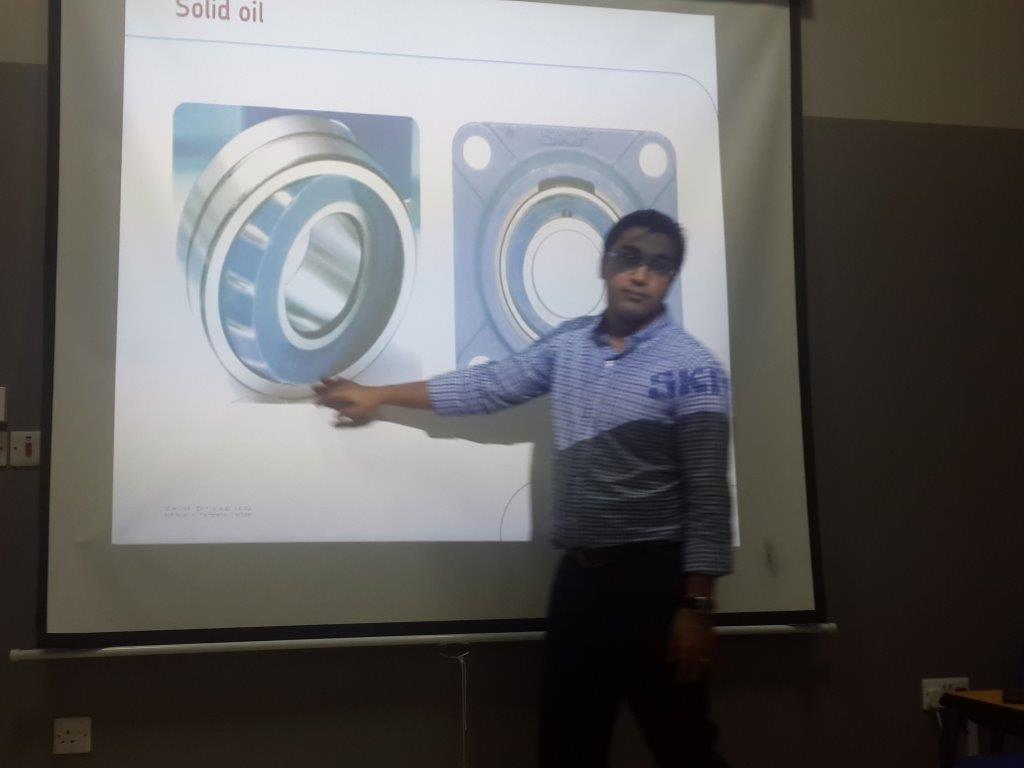
I worked in SKF from 2009 to 2019 and during my 10 years there, had seen a lot of lack of knowledge on this mode of lubrication in rolling bearings.
So wrote below to share all my knowledge and experiences in this area.
Solid Oil in Rolling Bearings
Introduction
Rolling bearings are used to support rotating shafts and reduce friction between moving machine parts. Their performance depends not only on bearing geometry and material quality, but also on lubrication. Without proper lubrication, the rolling elements and raceways experience metal-to-metal contact, heat generation, wear, corrosion, and eventually premature failure. Traditionally, rolling bearings are lubricated by oil or grease. Solid Oil is a third lubrication method in which the oil is held inside a solid polymer structure rather than supplied as free oil or thickened grease. SKF describes Solid Oil as an oil-saturated polymer matrix that fills the free space inside the bearing and surrounds the rolling elements and cage.
What Solid Oil Means
Solid Oil is not “solid oil” in the ordinary sense of frozen or hardened oil. It is a porous polymer material saturated with lubricating oil. The polymer contains many microscopic pores that retain oil by surface tension. When the bearing is operating, the oil is gradually released from the polymer surface into the contact zone between rolling elements and raceways. This allows lubrication to occur while keeping most of the lubricant locked inside the bearing.
In a conventional grease-lubricated bearing, the bearing cavity is usually only partly filled with grease. With Solid Oil, the internal free space of the bearing is filled much more completely. SKF states that a bearing with Solid Oil can contain two to four times more oil than a comparable grease-lubricated bearing. This larger oil reservoir is one of the main reasons Solid Oil is useful where relubrication is difficult or impossible.
Construction of a Solid Oil Bearing
A rolling bearing with Solid Oil has the same main mechanical parts as a standard bearing: inner ring, outer ring, rolling elements, and cage. The difference lies in the space around these components. Instead of being filled with grease, this space is filled with an oil-saturated polymer. During manufacture, the polymer material is introduced into the bearing so that it fills the cavity while still leaving a very narrow clearance around the rolling elements and raceways. This clearance allows the bearing parts to rotate freely while enabling oil to seep into the contact area.
The polymer matrix also supports the lubricant mechanically. In high-speed or rotating outer-ring applications, grease can be displaced by centrifugal force. Solid Oil is more resistant to this because the oil is retained inside a solid structure. The lubricant is therefore less likely to be thrown out of the bearing cavity.
Working Principle
The working principle of Solid Oil depends on controlled oil release. As the bearing rotates, the rolling elements pass close to the Solid Oil matrix. A thin oil film forms between the bearing surfaces, reducing friction and wear. When operating temperature rises, the oil tends to move toward the surface of the polymer because oil expands more than the polymer and its viscosity decreases with temperature. When the bearing stops and cools, excess oil can be reabsorbed into the polymer material.
This behavior gives Solid Oil a self-regulating character. It does not pump oil like a circulating oil system, but it continuously makes small amounts of oil available where needed. The system is especially effective when the bearing operates in conditions where ordinary grease may be washed out, displaced, or contaminated.
Advantages of Solid Oil in Rolling Bearings
The first major advantage is maintenance reduction. Bearings with Solid Oil are designed as relubrication-free solutions. SKF states that Solid Oil bearings are lubricated for the life of the bearing and cannot be relubricated. This makes them useful in locations where manual lubrication is unsafe, expensive, or physically difficult.
The second advantage is contamination protection. Because the Solid Oil matrix fills the bearing cavity, it is harder for water, dust, fibres, food particles, or other contaminants to reach the rolling contact surfaces. In wet environments, Solid Oil can also support contact seals from inside the bearing, helping prevent seal deflection during pressure washing.
The third advantage is reduced lubricant leakage. Grease or oil leakage can be a serious problem in food processing, paper production, textile machinery, pharmaceutical equipment, and clean manufacturing areas. Since the oil is retained inside the polymer matrix, Solid Oil greatly reduces the chance of lubricant escaping from the bearing and contaminating the product or surrounding equipment.
The fourth advantage is resistance to washout. In machines exposed to water spray or high-pressure cleaning, grease can emulsify, wash away, or lose consistency. SKF notes that Solid Oil cannot be washed out of the bearing in the same way, and water does not mix with the oil or polymer matrix.
The fifth advantage is performance in vertical shafts and high centrifugal-force applications. In vertical arrangements, ordinary oil or grease may migrate away from the contact zone. In Solid Oil bearings, the lubricant remains distributed throughout the bearing cavity. This helps keep the bearing lubricated even when gravity or centrifugal force would normally move lubricant away.
Limitations of Solid Oil
Solid Oil is not the best solution for every bearing application. Its main limitations are speed and temperature. SKF lists a maximum continuous operating temperature of 85 °C and a maximum intermittent operating temperature of 95 °C for standard Solid Oil bearing variants. Since operating temperature rises with speed, the permissible speed must often be reduced, especially in warm environments.
Solid Oil also adds a fixed amount of friction compared with the equivalent standard bearing. This means it is generally less suitable for very high-speed, very low-torque applications where minimum friction is essential. SKF’s product information states that the bearing’s friction characteristics correspond to the standard bearing except for the added friction from the polymer filling.
Another limitation is that Solid Oil bearings cannot be relubricated. This is an advantage in many maintenance-free applications, but it also means that once the lubricant supply is exhausted or degraded, the bearing must be replaced rather than replenished. In contrast, open oil- or grease-lubricated bearings can often be serviced during machine operation.
Chemical compatibility must also be considered. The polymer matrix is resistant to many chemicals, but SKF notes that organic solvents such as kerosene can remove oil from the polymer. Therefore, the cleaning agents, process fluids, and surrounding chemicals must be checked before selecting Solid Oil bearings.
Speed Selection
For Solid Oil bearings, speed selection is based on the bearing type, size, cage design, sealing arrangement, and ambient temperature. SKF expresses speed limits using the bearing mean diameter:
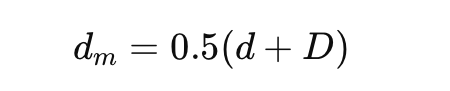
where (d) is the bearing bore diameter and (D) is the bearing outside diameter. Recommended speed limits are then given as values such as (300,000 / d_m) for certain single-row deep groove ball bearings with stamped metal cages at 20 °C ambient temperature. Bearings with integral seals should use 80% of the listed speed values.
For example, SKF gives a calculation for a 6208/W64 deep groove ball bearing with (d = 40) mm and (D = 80) mm. The mean diameter is 60 mm, so the 20 °C speed limit is (300,000 / 60 = 5,000) r/min. If the ambient temperature is 50 °C, SKF applies a reduction factor of about 0.53, giving a reduced speed limit of approximately 2,650 r/min.
Temperature and Mounting Considerations
Temperature control is important because the polymer and oil system has defined thermal limits. For standard Solid Oil bearings, the maximum continuous operating temperature is 85 °C, and the maximum intermittent temperature is 95 °C. SKF also lists minimum start-up temperatures depending on the oil variant; for the standard variant, the minimum start-up temperature is shown as –50 °C in one SKF technical table.
Mounting must also be handled carefully. SKF states that if a Solid Oil bearing is hot mounted, it should be heated using an induction heater, and heating plates or heated oil baths should not be used. This is because uncontrolled heating or oil-bath heating may damage or contaminate the polymer lubricant system.
Typical Applications
Solid Oil bearings are commonly selected for dirty, humid, wet, or hard-to-reach applications. Typical areas include food and beverage machinery, pharmaceutical equipment, paper machines, conveyors, cranes, marine equipment, pumps, agitators, and machinery exposed to water or process contamination. SKF specifically highlights use cases involving moisture, water contact, high contamination levels, and locations where relubrication is impractical or dangerous.
In food and beverage plants, bearings may be exposed to washdowns, detergents, water, and strict hygiene requirements. Solid Oil is useful here because it reduces lubricant leakage and helps resist washout. SKF also identifies food-grade Solid Oil variants, such as W64F, using NSF H1 registered oil.
In cranes, hoists, and inaccessible machinery, the main benefit is reduced maintenance. A bearing mounted high above ground or inside difficult equipment may be costly or unsafe to relubricate. A relubrication-free bearing can reduce downtime, labour, and safety risk.
Comparison with Grease and Oil Lubrication
Oil lubrication is effective where heat removal, high speed, or continuous lubricant circulation is required. Grease lubrication is simple, widely used, and suitable for many general industrial applications. Solid Oil sits between these methods: it provides oil lubrication, but the oil is stored in a solid polymer matrix. It is most valuable when the operating environment attacks conventional lubricants or when the bearing cannot be relubricated easily.
| Lubrication method | Main strength | Main weakness |
|---|---|---|
| Oil | Good for circulation, cooling, and high-speed systems | Can leak and may require pumps, seals, or reservoirs |
| Grease | Simple, common, and economical | Can wash out, age, leak, or require relubrication |
| Solid Oil | Retains oil inside the bearing, reduces leakage, resists washout, and avoids relubrication | Limited by temperature, speed, and inability to relubricate |
Conclusion
Solid Oil is a specialized lubrication solution for rolling bearings operating in harsh, wet, contaminated, clean, or inaccessible environments. Its oil-saturated polymer matrix stores a large quantity of oil, releases lubricant during operation, reduces contamination ingress, minimizes leakage, and eliminates relubrication. However, it must be selected carefully because speed, temperature, chemical exposure, mounting method, and bearing design all affect suitability. For high-speed or high-temperature applications, conventional oil lubrication or another specialized bearing solution may be more appropriate. For applications where grease fails because of washout, contamination, leakage, or poor accessibility, Solid Oil can significantly improve bearing reliability and maintenance performance.

