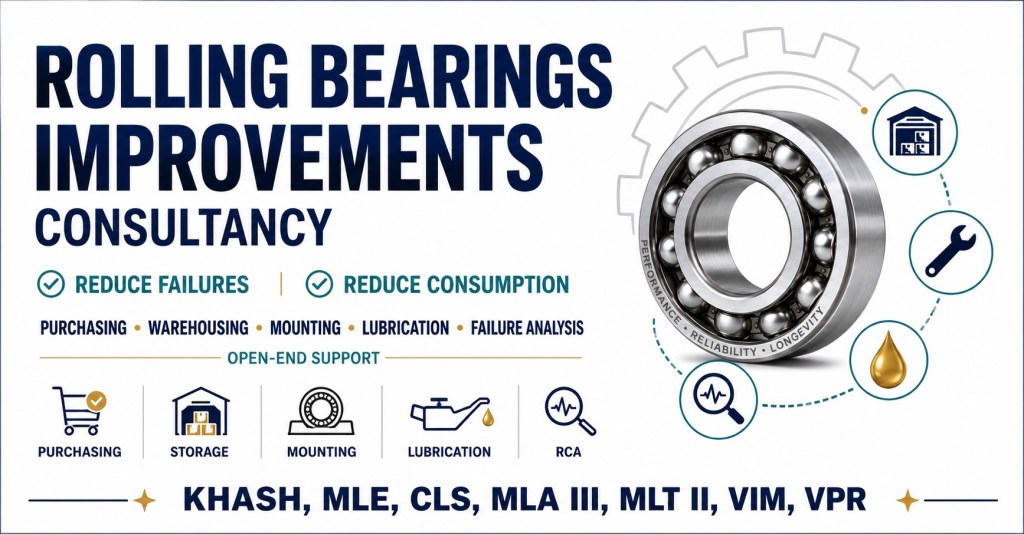
Below is a detailed working draft for the Rolling Bearings Improvements Consultancy Proposal and Open-Ended Consultancy Agreement by Khash. It is focused specifically on reducing rolling bearing failures, improving bearing lifecycle practices, and reducing unnecessary bearing consumption from purchasing through warehousing, mounting, dismounting, lubrication, inspection, and failure analysis.
Rolling Bearings Improvements Consultancy Proposal
Open-Ended Consultancy Agreement for Bearing Reliability, Failure Reduction, and Bearing Consumption Optimization
Submitted by: Khash
Credentials: MLE, CLS, MLA III, MLT II, VIM, VPR
Submitted to: [Client Name]
Site / Facility: [Plant / Site Name]
Effective Date: [Date]
Agreement Type: Open-Ended / Call-Off Consultancy Support Agreement
1. Executive Summary
Rolling bearings are among the most common and most critical machine components in industrial equipment. They are used in motors, pumps, gearboxes, fans, blowers, compressors, conveyors, crushers, mills, rollers, turbines, hydraulic units, mobile equipment, and many other rotating assets. Although bearings are precision-engineered components, their actual service life depends heavily on how they are selected, purchased, stored, handled, mounted, lubricated, monitored, removed, inspected, and analyzed after failure.
Khash proposes to provide specialized consultancy services to help [Client Name] improve rolling bearing reliability and reduce unnecessary bearing consumption. The proposed consultancy covers the full bearing lifecycle, beginning from purchasing and technical specification, continuing through warehousing and preservation, and extending into mounting, dismounting, lubrication, alignment, contamination control, condition monitoring, failure analysis, training, and continuous improvement.
The purpose of this consultancy is not only to reduce bearing failures after they occur, but to prevent failures before they are introduced into the system. Many bearing failures begin long before operation. A bearing can be damaged by incorrect specification, counterfeit or low-quality supply, poor storage, moisture exposure, contamination, rough handling, incorrect fitting, hammering, wrong heating practice, misalignment, excessive preload, incorrect internal clearance, over-lubrication, under-lubrication, wrong grease, poor sealing, electrical discharge, vibration during standby, or poor removal practices.
This agreement is designed as an open-ended consultancy agreement, meaning Khash may be called upon by [Client Name] whenever a specific bearing-related need arises. The client may request support for a single bearing failure, a repeated failure problem, a warehouse audit, a mounting training session, bearing standardization, lubrication improvement, failure analysis, procurement review, condition monitoring program, or a complete bearing reliability improvement program.
The consultancy approach is aligned with recognized bearing engineering principles and relevant standards. ISO 15243:2017 classifies rolling bearing damage and failures and describes failure characteristics, appearance, and possible root causes; it also notes that visual features alone may not always be enough and that additional investigation may be required in some cases. (ISO) ISO 281:2007 provides methods for calculating dynamic load ratings and basic or modified rating life, including the influence of reliability, lubrication condition, contaminated lubricant, and fatigue load, while noting that wear, corrosion, and electrical erosion are outside its bearing-life calculation scope. (ISO) ISO 492:2023 addresses dimensional and geometrical characteristics, deviation limits, and tolerance values for radial rolling bearings. (ITEH Standards)
The overall objective is clear: reduce bearing failures, reduce bearing consumption, improve machine reliability, improve technician practices, improve lubrication discipline, and create a structured bearing management system that delivers measurable reliability and cost benefits.
2. Purpose of the Consultancy Agreement
The purpose of this agreement is to establish a flexible technical consultancy framework under which Khash may provide professional support in all areas related to rolling bearing reliability and bearing lifecycle management.
This agreement allows [Client Name] to call Khash for specific bearing-related needs without preparing a new master contract every time. Each assignment may be activated through a call-off request, purchase order, service order, email approval, work instruction, or separately agreed scope of work.
The objectives of the agreement are to:
- Reduce premature rolling bearing failures.
- Reduce repeated failures on critical and chronic bad-actor equipment.
- Reduce unnecessary bearing consumption and stock wastage.
- Improve bearing purchasing specifications and supplier control.
- Improve warehouse storage, preservation, identification, and shelf-life control.
- Improve handling, transport, cleanliness, and damage prevention.
- Improve mounting and dismounting practices.
- Improve lubrication selection, quantity, frequency, and application method.
- Improve contamination control and sealing practices.
- Improve alignment, balancing, shaft fit, housing fit, and mechanical installation practices.
- Improve bearing inspection, condition monitoring, and failure analysis.
- Develop competency among maintenance, reliability, warehouse, and purchasing teams.
- Establish KPIs to measure bearing reliability and consumption reduction.
- Create a sustainable bearing improvement program rather than temporary corrective actions.
3. Background: Why Bearing Failures Must Be Managed as a System
A rolling bearing failure is rarely an isolated event. In many cases, the visible bearing damage is only the final symptom of a problem introduced elsewhere in the lifecycle.
For example, a bearing may fail in operation because it was contaminated during mounting. It may be contaminated during mounting because the mounting area was not clean, the package was opened too early, or the technician did not have the correct tools. The wrong tool may have been used because the job plan did not specify a proper method. The job plan may be weak because maintenance standards were not established. The bearing may have been overheated during installation because no temperature control was available. The wrong bearing may have been installed because the warehouse item master was unclear or because equivalent bearings were not technically reviewed.
Therefore, bearing reliability improvement must cover the full lifecycle:
Purchasing → Receiving → Warehousing → Handling → Mounting → Lubrication → Operation → Inspection → Dismounting → Failure Analysis → Corrective Action → Standardization
Khash’s consultancy will address this full cycle so that bearing improvements are not limited to replacing failed bearings, but instead focus on removing the causes of failure and reducing recurrence.
4. Main Consultancy Scope Offered by Khash
Khash may provide consultancy, auditing, training, technical review, field support, troubleshooting, failure investigation, documentation, and implementation support across the following bearing management areas.
4.1 Area 1 — Bearing Purchasing, Technical Specification, and Procurement Control
Poor bearing reliability can begin at the purchasing stage. Incorrect bearing selection, unclear specifications, non-approved equivalents, counterfeit parts, wrong clearance class, wrong cage type, wrong seal type, wrong precision class, wrong internal design, or poor supplier control can create failures before the bearing is even installed.
Khash can support the purchasing and procurement process to ensure that bearings supplied to the plant are technically correct, traceable, suitable for the application, and controlled against unauthorized substitutions.
4.1.1 Bearing Technical Specification Review
Khash may review existing bearing specifications for critical and common bearings, including:
- Bearing type
- Bearing number
- Internal clearance
- Precision class
- Cage type
- Seal or shield arrangement
- Lubrication feature
- Material requirement
- Heat treatment requirement
- Load capacity
- Speed rating
- Temperature capability
- Fit and tolerance requirements
- OEM recommendation
- Application requirement
- Operating environment
- Availability and interchangeability
- Supplier technical equivalency
The objective is to ensure that the purchased bearing matches the real operating requirement and is not selected only based on dimensional similarity.
4.1.2 Bearing Equivalency and Interchangeability Review
Khash may evaluate proposed alternative bearings from different manufacturers. This review may include:
- Dimensional equivalency
- Load rating comparison
- Speed rating comparison
- Internal geometry differences
- Clearance class
- Cage design
- Seal design
- Lubrication compatibility
- Operating temperature limits
- Material and heat treatment
- Precision and tolerance class
- OEM approval status
- Risk of substitution
- Application criticality
Not all equivalent bearing numbers are truly equivalent for a specific machine. Khash may help prevent unsuitable substitutions that could increase failure risk.
4.1.3 Approved Bearing List Development
Khash may help develop an approved bearing list for the site, including:
- Approved bearing numbers
- Approved manufacturers
- Approved alternatives
- Non-approved alternatives
- Critical application notes
- Required clearance class
- Required seal or shield type
- Required cage type
- Required grease or oil compatibility
- Procurement notes
- Inspection requirements
- Minimum documentation requirements
4.1.4 Supplier Qualification and Technical Evaluation
Khash may support procurement in evaluating bearing suppliers, including:
- Authorized distributor status
- Manufacturer traceability
- Certificate of conformity
- Country of origin documentation
- Batch traceability
- Packaging condition
- Storage condition at supplier warehouse
- Technical support capability
- Warranty process
- Failure analysis support
- Delivery quality history
- Counterfeit risk control
4.1.5 Counterfeit and Non-Conforming Bearing Risk Control
Khash may help create controls to reduce the risk of counterfeit, expired, mishandled, or non-conforming bearings entering the plant.
Controls may include:
- Approved supplier list
- Packaging inspection
- Label verification
- Traceability review
- Visual inspection
- Certificate review
- Comparison with genuine samples
- Quarantine procedure
- Non-conformance report process
- Supplier corrective action process
4.1.6 Bearing Standardization and Consumption Optimization
Khash may conduct a bearing rationalization study to reduce unnecessary variety and improve standardization without compromising technical suitability.
This may include:
- Reviewing all bearing item codes
- Identifying duplicate items
- Identifying obsolete items
- Identifying incorrect descriptions
- Identifying same bearing stored under multiple codes
- Identifying rarely used but critical bearings
- Identifying non-critical excessive stock
- Improving minimum and maximum levels
- Improving reorder levels
- Improving critical spare classification
- Reducing emergency purchases
- Reducing wrong-bearing issue events
Typical deliverables:
- Bearing procurement review report
- Approved bearing list
- Bearing equivalency matrix
- Supplier technical evaluation report
- Bearing item master cleanup recommendations
- Counterfeit risk control procedure
- Bearing standardization and rationalization plan
- Procurement technical specification template
- Bearing receiving inspection checklist
4.2 Area 2 — Bearing Receiving Inspection and Quality Control
Even if the correct bearing is ordered, risk remains during receiving. A bearing may arrive with damaged packaging, missing traceability, incorrect clearance, wrong suffix, wrong seal type, corrosion, improper preservation, or transport damage.
Khash can support receiving and stores teams in developing inspection and acceptance procedures.
4.2.1 Incoming Bearing Inspection
Khash may define receiving inspection requirements, including:
- Purchase order verification
- Bearing number verification
- Suffix verification
- Clearance class verification
- Seal or shield type verification
- Cage type verification
- Manufacturer verification
- Packaging condition
- Corrosion protection condition
- Label and barcode verification
- Certificate of conformity review
- Damage inspection
- Shelf-life status
- Documentation control
4.2.2 Quarantine and Non-Conformance Procedure
Khash may develop a process for quarantining bearings that do not meet requirements, including:
- Damaged packaging
- Missing certificate
- Wrong bearing number
- Wrong clearance
- Suspected counterfeit
- Corrosion signs
- Contamination exposure
- Expired or unknown shelf life
- Incorrect supplier
- Missing traceability
4.2.3 Critical Bearing Receiving Requirements
For critical bearings, Khash may recommend enhanced controls such as:
- Dedicated receiving inspection
- Manufacturer documentation review
- Photo record
- Preservation verification
- Controlled storage location
- No issue without technical approval
- Pre-installation inspection
- Fit and application confirmation
Typical deliverables:
- Bearing receiving inspection procedure
- Bearing receiving checklist
- Quarantine procedure
- Non-conformance report template
- Critical bearing receiving control plan
- Supplier corrective action template
4.3 Area 3 — Bearing Warehousing, Storage, Preservation, and Inventory Control
Bearing storage has a direct impact on bearing life. Bearings are precision components with finished raceways, rolling elements, cages, seals, and corrosion protection. Poor storage can cause corrosion, brinelling, fretting, contamination, seal degradation, grease aging, and loss of traceability.
Bearing manufacturers emphasize clean, controlled storage and careful handling. For example, NTN guidance states that most rolling bearings are coated with rust-preventive oil before shipment and recommends indoor storage at room temperature with relative humidity below 60%, avoiding sunlight, external walls, and direct ground storage. (ntnglobal.com)
4.3.1 Warehouse Audit
Khash may audit the bearing warehouse and evaluate:
- Cleanliness
- Temperature control
- Humidity control
- Dust exposure
- Packaging condition
- Storage height
- Shelf condition
- Floor storage practices
- Vibration exposure
- Proximity to chemicals
- Proximity to wash bays or open doors
- FIFO discipline
- Shelf-life control
- Item identification
- Barcode accuracy
- Duplicate items
- Critical spare storage
- Obsolete stock
- Opened boxes
- Greased bearing shelf life
- Sealed bearing shelf life
- Corrosion protection
- Handling practices
- Preservation records
4.3.2 Bearing Storage Standard
Khash may develop a bearing storage standard covering:
- Storage temperature expectations
- Humidity control
- Packaging requirements
- Shelf location requirements
- No direct floor storage
- Protection from vibration
- Protection from dust and moisture
- Handling requirements
- Rotation of stock
- Inspection frequency
- Expiry review
- Opened-package control
- Preservation of large bearings
- Storage orientation for precision or thin-section bearings
- Critical bearing segregation
- Returned bearing control
4.3.3 Shelf-Life and Preservation Control
Khash may help define shelf-life controls for:
- Open bearings
- Sealed bearings
- Greased-for-life bearings
- Precision bearings
- Large bearings
- Bearings with special coatings
- Bearings with polymer cages
- Bearings with rubber seals
- Bearings with corrosion-preventive oils
- Bearings stored in high-humidity regions
4.3.4 Bearing Inventory Optimization
Khash may support inventory optimization to reduce both shortages and overstock. The review may include:
- Fast-moving bearings
- Slow-moving bearings
- Critical bearings
- Duplicate item codes
- Wrong descriptions
- Alternative bearing codes
- Minimum and maximum levels
- Reorder quantity
- Emergency purchase history
- Failure-driven consumption
- Planned replacement consumption
- Excess stock caused by repeated failures
- Obsolete equipment bearings
- Stored bearings with unknown history
Typical deliverables:
- Bearing warehouse audit report
- Bearing storage standard
- Bearing preservation procedure
- Bearing inventory cleanup report
- Shelf-life control register
- Critical bearing storage plan
- FIFO and inspection checklist
- Bearing item master correction list
- Obsolete and duplicate stock report
4.4 Area 4 — Bearing Handling, Transport, and Pre-Mounting Cleanliness
Rolling bearings can be damaged before installation through impact, contamination, moisture, wrong lifting, dirty benches, poor hand tools, damaged packaging, or opening the package too early.
Khash can support the development of correct handling practices from warehouse issue until final installation.
4.4.1 Bearing Handling Procedure
Khash may develop procedures covering:
- Clean handling
- Package opening timing
- Use of gloves
- Avoiding direct contact with dirty hands
- Avoiding impact
- Avoiding dropping
- Avoiding bearing spinning with compressed air
- Avoiding contamination during transport
- Dedicated transport boxes
- Protection from rain and dust
- Use of clean benches
- Use of lint-free cloth
- Protection of bearing raceways
- Handling of large bearings
- Handling of precision bearings
- Handling of sealed bearings
- Handling of pre-greased bearings
4.4.2 Pre-Mounting Area Control
Khash may evaluate and improve bearing mounting work areas, including:
- Cleanliness
- Dust control
- Bench condition
- Tool condition
- Lighting
- Availability of correct tools
- Availability of lifting equipment
- Availability of heating equipment
- Availability of measuring tools
- Protection from grinding, welding, and blasting dust
- Control of open bearing exposure
- Control of grease and lubricant contamination
Schaeffler’s mounting guidance emphasizes that correct mounting and dismounting methods, along with cleanliness and care at the assembly site, are necessary for long bearing service life. (schaeffler.com)
Typical deliverables:
- Bearing handling procedure
- Bearing transport procedure
- Clean mounting area checklist
- Bearing handling training material
- Pre-mounting inspection checklist
- Clean bench and tool requirement list
4.5 Area 5 — Bearing Mounting and Installation Practices
Incorrect mounting is one of the most common causes of premature bearing damage. A high-quality bearing can fail rapidly if it is installed with incorrect force, wrong fit, wrong heating temperature, contamination, misalignment, excessive preload, incorrect clearance reduction, wrong spacer, incorrect locknut torque, or poor seating.
Khash may provide technical support, field coaching, and procedure development for bearing mounting.
4.5.1 Mounting Method Review
Khash may review and recommend correct mounting methods, including:
- Cold mounting
- Mechanical mounting
- Hydraulic mounting
- Induction heating
- Oil bath heating where permitted
- Hot plate heating where appropriate
- Press mounting
- Adapter sleeve mounting
- Withdrawal sleeve mounting
- Tapered seat mounting
- Large bearing mounting
- Spherical roller bearing mounting
- Tapered roller bearing mounting
- Angular contact bearing mounting
- Deep groove ball bearing mounting
- Cylindrical roller bearing mounting
- Split bearing mounting
- Self-aligning bearing mounting
4.5.2 Mounting Tools and Equipment
Khash may evaluate and recommend proper mounting tools such as:
- Bearing fitting tool kits
- Hydraulic nuts
- Hydraulic pumps
- Feeler gauges
- Dial indicators
- Bore gauges
- Micrometers
- Torque wrenches
- Locknut sockets
- Induction heaters
- Temperature probes
- Thermal crayons
- Clean lifting slings
- Bearing heaters with demagnetization
- Puller sets
- Mounting sleeves
- Impact-free installation tools
- Clearance measurement tools
4.5.3 Fit, Tolerance, and Shaft/Housing Review
Khash may review shaft and housing conditions that influence bearing life, including:
- Shaft diameter
- Housing bore diameter
- Roundness
- Taper
- Cylindricity
- Surface finish
- Shoulder height
- Fillet radius
- Seat damage
- Fretting corrosion
- Loose fit
- Excessive interference
- Housing distortion
- Soft foot
- Thermal expansion
- Bearing internal clearance selection
- Fit selection based on rotating load
- Fit selection based on load intensity
- Fit selection based on temperature
ISO 492:2023 is relevant to radial bearing dimensional and geometrical characteristics and tolerance values, which makes fit control and interface accuracy important when assessing bearing installation quality. (ITEH Standards)
4.5.4 Internal Clearance and Preload Control
Khash may help define correct practices for internal clearance and preload, including:
- Selecting correct clearance class
- Measuring initial clearance
- Measuring clearance reduction
- Avoiding excessive clearance reduction
- Avoiding excessive preload
- Understanding thermal effects
- Matching clearance to fit and operating temperature
- Reviewing tapered bore mounting
- Reviewing angular contact bearing preload
- Reviewing tapered roller bearing end play
- Verifying axial location
- Documenting final readings
4.5.5 Mounting Procedure Development
Khash may prepare detailed mounting procedures for critical machines, including:
- Required bearing
- Required tools
- Required lubricant
- Required drawings
- Shaft and housing inspection
- Pre-cleaning steps
- Measurement steps
- Mounting method
- Heating temperature limits
- Clearance or preload requirements
- Torque requirements
- Lubrication steps
- Seal installation
- Post-mounting rotation check
- Runout check
- Final inspection
- Startup checks
- Documentation requirements
4.5.6 Installation Witnessing and Field Coaching
Khash may attend bearing installation activities to:
- Verify cleanliness
- Verify correct bearing
- Verify tools
- Verify measurements
- Coach technicians
- Identify bad practices
- Record installation data
- Review fit and clearance
- Confirm lubrication
- Confirm post-installation inspection
Typical deliverables:
- Bearing mounting procedure
- Critical bearing installation checklist
- Mounting method selection guide
- Tooling gap report
- Shaft and housing measurement checklist
- Internal clearance calculation sheet
- Preload/endplay control procedure
- Installation witness report
- Technician coaching report
4.6 Area 6 — Bearing Dismounting, Removal, and Maintenance Practices
Dismounting is often treated as a simple removal activity, but it is highly important for reliability improvement. Poor dismounting can damage shafts, housings, seals, spacers, sleeves, and adjacent components. It can also destroy failure evidence before analysis.
Khash may provide support to improve dismounting practices and preserve evidence for root cause analysis.
4.6.1 Dismounting Method Review
Khash may review and recommend correct dismounting methods, including:
- Mechanical pullers
- Hydraulic pullers
- Hydraulic nuts
- Oil injection methods
- Induction heaters
- Controlled cutting where unavoidable
- Support of large bearings
- Adapter sleeve removal
- Withdrawal sleeve removal
- Safe handling of hot components
- Safe handling of stuck bearings
- Avoiding damage to shafts and housings
4.6.2 Failure Evidence Preservation
Khash may develop a failed-bearing preservation process, including:
- Do not clean failed bearing before inspection unless instructed
- Do not hammer failed bearing surfaces
- Do not grind bearing surfaces
- Do not mix bearing components
- Keep inner ring, outer ring, rolling elements, cage, seals, and grease together
- Label bearing location and orientation
- Photograph before removal
- Photograph during removal
- Record operating hours
- Record lubricant used
- Record failure symptoms
- Record vibration and temperature history
- Record oil or grease sample data
- Store failed bearing in clean bag or container
- Prevent corrosion after removal
- Send to analysis with full context
4.6.3 Shaft, Housing, and Accessory Inspection
After bearing removal, Khash may inspect or recommend inspection of:
- Shaft seats
- Housing seats
- Fretting marks
- Wear marks
- Scoring
- Corrosion
- Out-of-round condition
- Oversize or undersize condition
- Shoulder damage
- Seal wear tracks
- Spacer condition
- Locknut condition
- Sleeve condition
- Lubrication holes
- Drain paths
- Contamination marks
Typical deliverables:
- Bearing dismounting procedure
- Failed bearing preservation procedure
- Dismounting checklist
- Failure evidence collection form
- Shaft and housing inspection checklist
- Post-removal inspection report
- Corrective action recommendations
4.7 Area 7 — Bearing Lubrication Improvement
Lubrication is one of the most important drivers of rolling bearing life. The wrong lubricant, wrong quantity, wrong interval, wrong application method, contamination, moisture, grease incompatibility, or poor relubrication route can lead to premature failure.
Khash, with strong lubrication qualifications and experience, can support the bearing lubrication program in detail.
4.7.1 Bearing Lubricant Selection
Khash may review and recommend correct lubricants for bearing applications, considering:
- Bearing type
- Speed
- Load
- Temperature
- Environment
- Sealing arrangement
- Relubrication method
- Grease thickener type
- Base oil viscosity
- Base oil type
- Additive package
- NLGI grade
- Dropping point
- Mechanical stability
- Water resistance
- Oxidation stability
- Low-temperature performance
- High-temperature performance
- Compatibility with seals
- Compatibility with existing grease
- Food-grade requirements
- Electric motor requirements
- High-speed bearing requirements
- Shock-load requirements
- Vibration conditions
4.7.2 Grease Quantity and Frequency Calculation
Khash may calculate or verify grease quantities and relubrication intervals for rolling bearings based on:
- Bearing dimensions
- Bearing type
- Speed factor
- Operating temperature
- Load
- Contamination exposure
- Moisture exposure
- Vertical or horizontal shaft orientation
- Bearing housing design
- Seal type
- Grease type
- Purge path
- Operating hours
- Criticality
4.7.3 Over-Greasing and Under-Greasing Control
Khash may investigate and correct over-greasing and under-greasing problems, including:
- Excessive motor bearing temperature
- Grease churning
- Seal damage
- Grease leakage
- Starved bearings
- Lack of purge
- Hardened grease
- Incompatible grease mixture
- Over-pressurization
- Wrong grease gun output
- Uncontrolled manual greasing
- Lack of ultrasonic feedback
- Wrong PM frequency
4.7.4 Grease Gun and Lubrication Tool Control
Khash may define controls for:
- Grease gun calibration
- Grease output per stroke
- Dedicated grease guns by lubricant type
- Color coding
- Clean couplers
- Grease meter use
- Ultrasonic lubrication tools
- Automatic lubricator setup
- Single-point lubricator selection
- Centralized lubrication system checks
- Grease storage and dispensing cleanliness
4.7.5 Bearing Lubrication Route Optimization
Khash may develop or improve bearing lubrication routes, including:
- Route sequence
- Lubricant type
- Quantity
- Frequency
- Method
- Tool
- Safety requirement
- Machine running or stopped condition
- Inspection points
- Feedback readings
- Abnormal condition triggers
- CMMS task description
- Corrective work order triggers
4.7.6 Sealed and Greased-for-Life Bearing Review
Khash may review whether sealed or greased-for-life bearings are suitable, considering:
- Temperature
- Speed
- Load
- Contamination exposure
- Expected service life
- Accessibility
- Cost of replacement
- Risk of relubrication error
- Environmental exposure
- OEM design requirement
Typical deliverables:
- Bearing lubrication review report
- Bearing grease selection matrix
- Bearing relubrication calculation sheet
- Lubrication route sheets
- Grease gun calibration procedure
- Over-greasing/under-greasing investigation report
- Automatic lubricator recommendation
- Bearing lubrication standard operating procedure
- Bearing lubrication CMMS job plans
4.8 Area 8 — Contamination Control, Sealing, and Cleanliness
Contamination is one of the most destructive causes of rolling bearing failure. Solid particles can dent raceways, increase wear, initiate fatigue, damage cages, and shorten grease or oil life. Water can cause corrosion, hydrogen-related damage mechanisms, lubricant degradation, grease softening or hardening, and loss of film strength.
Khash may support contamination control for bearing applications.
4.8.1 Contamination Source Identification
Khash may identify contamination sources such as:
- Dirty mounting environment
- Opened bearing packaging
- Dirty grease guns
- Dirty grease fittings
- Damaged seals
- Poor bearing housing design
- Moisture ingress
- Washdown exposure
- Dust exposure
- Process material ingress
- Breather problems
- Poor storage
- Contaminated lubricant
- Poor purge practice
- Contaminated tools
- Dirty shaft or housing during installation
4.8.2 Sealing Review
Khash may review bearing sealing arrangements, including:
- Contact seals
- Non-contact seals
- Labyrinth seals
- V-ring seals
- Taconite seals
- Bearing isolators
- Grease purge arrangements
- Housing seals
- Shaft sleeve condition
- Seal wear tracks
- Seal compatibility with lubricant
- Seal suitability for dust, moisture, steam, chemicals, or washdown
4.8.3 Cleanliness Standards
Khash may establish cleanliness expectations for:
- Bearing storage
- Mounting benches
- Tools
- Grease transfer
- Lubricant containers
- Housings
- Shafts
- Seals
- Automatic lubrication reservoirs
- Oil-lubricated bearing systems
- Critical bearing rebuilds
Typical deliverables:
- Bearing contamination control assessment
- Sealing improvement report
- Cleanliness checklist
- Bearing housing improvement recommendations
- Lubricant cleanliness control plan
- Seal selection review
- Contamination root cause report
4.9 Area 9 — Alignment, Balancing, Machine Condition, and Operating Factors
A bearing may fail even when it is correctly purchased, stored, mounted, and lubricated if the machine is misaligned, unbalanced, overloaded, operating at high temperature, exposed to vibration, or affected by resonance.
Khash may support bearing reliability by reviewing the operating and mechanical conditions that influence bearing stress.
4.9.1 Alignment Review
Khash may review:
- Shaft alignment
- Coupling alignment
- Thermal growth correction
- Soft foot
- Pipe strain
- Baseplate condition
- Machine movement after startup
- Alignment procedure quality
- Alignment tool calibration
- Alignment acceptance criteria
4.9.2 Balance and Vibration Review
Khash may review:
- Unbalance
- Misalignment signatures
- Looseness
- Resonance
- Bearing defect frequencies
- Gear mesh effects
- Electrical faults in motors
- Belt defects
- Pulley alignment
- Fan blade buildup
- Cavitation effects
- Structural looseness
- Foundation issues
4.9.3 Operating Condition Review
Khash may review operating factors such as:
- Overload
- Low-load skidding
- Rapid starts and stops
- Standby vibration
- High temperature
- Low temperature
- Process contamination
- Moisture exposure
- Incorrect operating speed
- Poor cooling
- Poor ventilation
- Electrical discharge through bearings
- VFD-related bearing currents
- Poor grounding
- Improper bearing insulation
Typical deliverables:
- Bearing operating condition review
- Alignment improvement recommendations
- Vibration and bearing condition summary
- Bad actor equipment review
- Electrical discharge risk review
- Corrective action list
- Reliability improvement plan
4.10 Area 10 — Bearing Condition Monitoring and Inspection
Bearing failures should be detected early enough to plan maintenance before catastrophic damage occurs. Khash may support the improvement of condition monitoring and inspection practices.
4.10.1 Bearing Inspection Program
Khash may develop inspection standards covering:
- Noise
- Temperature
- Vibration
- Lubricant leakage
- Grease condition
- Seal condition
- Contamination signs
- Housing condition
- Oil level
- Grease purge condition
- Abnormal smell
- Looseness
- Coupling condition
- Foundation bolts
- Dust buildup
- Motor bearing condition
- Fan and pump bearing housings
4.10.2 Vibration and Ultrasound Integration
Khash may support the use of vibration and ultrasound for:
- Early bearing defect detection
- Lubrication condition monitoring
- Grease quantity feedback
- Over-greasing prevention
- Under-lubrication detection
- Trending bearing condition
- Confirming corrective action effectiveness
4.10.3 Thermal Monitoring
Khash may support temperature monitoring through:
- Infrared inspection
- Contact temperature readings
- Temperature trending
- Alarm limits
- Post-lubrication temperature verification
- Startup temperature checks
- Bearing housing temperature standards
4.10.4 Oil and Grease Analysis for Bearings
For oil-lubricated bearings, Khash may review oil analysis data including:
- Wear metals
- Particle count
- Water
- Viscosity
- Oxidation
- Additive depletion
- Ferrous density
- Debris analysis
- Filter debris
- Microscopic wear particle analysis
For grease-lubricated bearings, Khash may recommend grease analysis where appropriate, including:
- Consistency change
- Contamination
- Wear debris
- Oxidation
- Remaining useful grease condition
- Base oil separation
- Thickener condition
Typical deliverables:
- Bearing inspection checklist
- Bearing condition monitoring plan
- Ultrasound lubrication route recommendation
- Temperature monitoring guideline
- Oil/grease analysis recommendation
- Bearing alarm and action matrix
- Monthly bearing condition report
4.11 Area 11 — Bearing Failure Analysis and Root Cause Analysis
Bearing replacement alone does not solve repeated failures. If the failed bearing is not analyzed, the same failure mechanism may continue. Khash may provide structured bearing failure analysis and root cause analysis.
4.11.1 Failure Analysis Method
Khash may conduct failure analysis based on:
- Failure history
- Equipment history
- Bearing application
- Bearing number and suffix
- Operating hours
- Installation history
- Lubricant history
- Lubrication route records
- Grease quantity and frequency
- Vibration data
- Temperature data
- Load and speed
- Shaft and housing fit
- Alignment records
- Failed bearing visual inspection
- Damage pattern identification
- Cage condition
- Rolling element condition
- Raceway condition
- Seal condition
- Corrosion signs
- Wear signs
- Electrical erosion signs
- Lubricant condition
- Contamination evidence
ISO 15243:2017 is directly relevant to this process because it classifies rolling bearing damage and failure modes and describes their appearance and possible causes. (ISO)
4.11.2 Common Bearing Failure Modes Investigated
Khash may investigate damage related to:
- Rolling contact fatigue
- Surface distress
- Abrasive wear
- Adhesive wear
- Corrosion
- Fretting corrosion
- False brinelling
- Plastic deformation
- True brinelling
- Electrical erosion
- Fluting
- Cage damage
- Smearing
- Scoring
- Overheating
- Lubricant starvation
- Over-lubrication
- Contamination denting
- Moisture damage
- Incorrect fit
- Excessive preload
- Insufficient clearance
- Misalignment
- Shaft current damage
- Poor mounting force path
- Seal failure
- Handling damage
4.11.3 Root Cause Analysis
Khash may facilitate RCA using methods such as:
- 5 Why analysis
- Fishbone diagram
- Fault tree analysis
- Failure mode and effects review
- Evidence-based cause mapping
- Maintenance practice review
- Lubrication practice review
- Procurement review
- Warehouse review
- Human-factor review
- Procedure compliance review
4.11.4 Corrective and Preventive Actions
Khash may develop practical corrective and preventive actions such as:
- Change bearing type
- Change clearance class
- Change cage type
- Change seal type
- Improve fit
- Repair shaft
- Repair housing
- Improve alignment
- Improve balance
- Change lubricant
- Adjust grease quantity
- Adjust grease frequency
- Improve contamination control
- Improve mounting tools
- Improve warehouse storage
- Improve supplier control
- Introduce training
- Modify CMMS task
- Add inspection point
- Add ultrasound monitoring
- Improve failed bearing preservation
- Add electrical grounding or insulated bearing solution where justified
Typical deliverables:
- Bearing failure analysis report
- RCA report
- Failure evidence photographs
- Failure mode classification
- Cause-and-effect analysis
- Corrective action plan
- Preventive action plan
- Updated mounting/lubrication recommendations
- Repeat failure prevention report
- Lessons learned document
4.12 Area 12 — Training, Competency, and Field Coaching
Bearing reliability depends heavily on technician competency. Even the best bearing and lubricant will fail if technicians do not understand correct handling, mounting, lubrication, and failure preservation.
Khash may provide practical and classroom training for relevant teams.
4.12.1 Training Topics
Training may include:
- Rolling bearing fundamentals
- Bearing types and applications
- Bearing numbering and suffixes
- Bearing internal clearance
- Bearing fits and tolerances
- Bearing storage and preservation
- Bearing handling and cleanliness
- Mounting methods
- Dismounting methods
- Use of induction heaters
- Use of hydraulic tools
- Grease lubrication fundamentals
- Grease quantity and frequency
- Over-greasing and under-greasing
- Contamination control
- Sealing systems
- Bearing condition monitoring
- Bearing failure modes
- Failure evidence preservation
- Bearing RCA
- Warehouse and purchasing controls
4.12.2 Role-Based Training
Khash may develop role-based training for:
- Maintenance technicians
- Reliability engineers
- Condition monitoring technicians
- Lubrication technicians
- Warehouse staff
- Purchasing staff
- Supervisors
- Planners
- Operations personnel
- Contractors
4.12.3 Field Coaching
Khash may provide practical coaching during:
- Bearing removal
- Bearing inspection
- Shaft and housing measurement
- Bearing heating
- Bearing mounting
- Grease application
- Startup inspection
- Failure evidence preservation
- RCA workshop
Typical deliverables:
- Bearing training matrix
- Training materials
- Attendance record
- Competency checklist
- Practical assessment form
- Field coaching report
- Technician improvement recommendations
4.13 Area 13 — CMMS, Job Plans, and Work Management
Bearing reliability improvements must be embedded into daily maintenance systems. Khash may support CMMS improvement to ensure bearing-related tasks are clear, accurate, and repeatable.
Services may include:
- Bearing replacement job plans
- Critical bearing installation procedures
- Lubrication PM review
- Inspection route development
- Failed bearing preservation task
- Alignment task requirement
- Shaft and housing measurement requirement
- Tool list inclusion
- Safety steps
- Quality hold points
- Post-maintenance checks
- Startup checks
- Failure codes
- Cause codes
- Bearing consumption tracking
- Repeat failure flags
- Corrective action tracking
Typical deliverables:
- CMMS bearing PM cleanup report
- Bearing replacement job plan templates
- Bearing failure code recommendations
- Work order feedback fields
- Bearing quality hold-point checklist
- Maintenance planner guidance document
4.14 Area 14 — Bearing Consumption Reduction and Cost Optimization
The goal is not simply to buy cheaper bearings. The goal is to reduce the total cost of bearing ownership by reducing failures, emergency purchases, rework, downtime, wasted inventory, wrong installations, and unnecessary replacements.
Khash may support bearing consumption reduction through:
- Historical consumption review
- Cost by equipment
- Cost by bearing type
- Cost by failure mode
- Repeat failure identification
- Emergency purchase tracking
- Stock duplication review
- Replaced-but-not-failed bearing review
- Condition-based replacement opportunities
- PM interval review
- Over-maintenance identification
- Bad actor ranking
- High-consumption area review
- Supplier performance review
- Lubrication-related consumption review
- Maintenance practice improvement
Suggested KPIs:
- Total bearing consumption per month
- Bearing consumption by area
- Bearing cost by asset
- Emergency bearing purchases
- Repeat bearing failures
- Mean time between bearing failures
- Percentage of bearing failures analyzed
- Percentage of failures with RCA completed
- Percentage of corrective actions closed
- Number of wrong-bearing issue events
- Number of bearing warehouse non-conformances
- Lubrication compliance for bearing points
- Over-greasing incidents
- Under-greasing incidents
- Bearing installation quality audit score
- Critical bearing storage compliance
- Bearing-related downtime
- Bearing-related maintenance cost
Typical deliverables:
- Bearing consumption analysis report
- Bad actor bearing list
- Bearing cost reduction roadmap
- High-consumption asset review
- Bearing KPI dashboard
- Monthly/quarterly bearing reliability report
- Cost avoidance summary
5. Proposed Rolling Bearing Improvement Program by Khash
Khash recommends a structured program rather than isolated troubleshooting. The program may be implemented in phases.
Phase 1 — Kick-Off and Data Collection
Khash will request and review available information such as:
- Bearing consumption history
- Bearing purchase records
- Bearing stock list
- Critical bearing list
- Equipment failure history
- CMMS work orders
- Lubrication PMs
- Vibration reports
- Oil analysis reports
- Grease types used
- Bearing supplier list
- Warehouse procedures
- Mounting procedures
- Training records
- OEM manuals
- Drawings
- Alignment reports
- Root cause reports
Phase 2 — Site Assessment
Khash may conduct a field assessment covering:
- Bearing warehouse
- Receiving process
- Critical bearing storage
- Maintenance workshop
- Mounting area cleanliness
- Tool availability
- Induction heater use
- Puller and hydraulic tool availability
- Lubrication tools
- Grease storage
- Bearing handling practices
- Dismounting practices
- Failed bearing preservation
- Bad actor machines
- Condition monitoring practices
- CMMS job plans
Phase 3 — Gap Analysis
Khash will identify gaps related to:
- Purchasing
- Supplier control
- Item master accuracy
- Storage and preservation
- Handling
- Mounting
- Dismounting
- Lubrication
- Contamination control
- Alignment and balancing
- Inspection
- Condition monitoring
- Failure analysis
- Training
- KPIs
- Management ownership
Phase 4 — Risk Ranking and Improvement Roadmap
Findings may be ranked according to:
- Safety risk
- Production impact
- Failure frequency
- Cost impact
- Ease of implementation
- Required investment
- Reliability benefit
- Urgency
The roadmap may include:
- Immediate corrective actions
- Quick wins
- Medium-term improvements
- Long-term system improvements
- Required tools
- Required training
- Required procedure updates
- CMMS changes
- Warehouse changes
- Procurement changes
- KPI tracking
Phase 5 — Implementation Support
Khash may support implementation through:
- Procedure writing
- Training
- Field coaching
- Tool specification
- Warehouse improvement
- Mounting audits
- Lubrication optimization
- Failure analysis
- CMMS task improvement
- Monthly reporting
- Management review meetings
Phase 6 — Verification and Continuous Improvement
Khash may help verify results through:
- Reduction in repeat failures
- Reduced bearing consumption
- Improved bearing installation quality
- Improved lubrication compliance
- Improved warehouse audit score
- Improved RCA completion rate
- Lower emergency purchases
- Lower bearing-related downtime
- Improved technician competency
6. Open-Ended Consultancy Agreement Structure
This agreement is intended to operate as a master consultancy framework. It does not obligate [Client Name] to issue a fixed amount of work, and it does not obligate Khash to perform any assignment unless the specific request is accepted by both parties.
6.1 Call-Off Request
[Client Name] may request Khash’s services for any bearing-related requirement, including:
- Repeated bearing failure
- Emergency bearing failure investigation
- Bearing warehouse audit
- Mounting or dismounting training
- Lubrication review
- Bearing specification review
- Bearing supplier review
- Bearing consumption reduction study
- Bad actor machine investigation
- Critical bearing installation witnessing
- Failed bearing analysis
- RCA workshop
- CMMS bearing PM review
- Bearing standardization project
- Condition monitoring improvement
- Shutdown bearing support
The call-off request should include, where available:
- Site or area
- Equipment tag number
- Bearing type or number
- Problem description
- Urgency
- Required support date
- Required deliverable
- Available data
- Contact person
- Purchase order or authorization
6.2 Scope Confirmation
For each assignment, Khash may issue a short scope confirmation defining:
- Objective
- Scope of work
- Methodology
- Required client support
- Required documents
- Site access needs
- Deliverables
- Commercial terms
- Assumptions
- Exclusions
Work may begin after written acceptance by [Client Name], unless emergency support is verbally approved and then confirmed in writing.
6.3 Types of Support
Khash may provide:
- Remote technical consultation
- On-site assessment
- Field inspection
- Installation witnessing
- Failed bearing inspection
- Failure analysis
- RCA facilitation
- Training
- Warehouse audit
- Procurement review
- CMMS review
- Lubrication review
- Condition monitoring review
- Monthly or quarterly advisory support
7. Deliverables Available Under This Agreement
Depending on the assignment, Khash may provide:
- Rolling bearing reliability assessment report
- Bearing lifecycle gap analysis
- Bearing procurement specification
- Approved bearing list
- Bearing equivalency matrix
- Supplier technical evaluation report
- Counterfeit risk control procedure
- Receiving inspection checklist
- Bearing warehouse audit report
- Bearing storage and preservation standard
- Bearing item master cleanup list
- Bearing handling procedure
- Mounting procedure
- Dismounting procedure
- Critical bearing installation checklist
- Shaft and housing inspection checklist
- Internal clearance measurement procedure
- Preload/endplay control procedure
- Bearing lubrication standard
- Grease quantity and frequency calculations
- Lubrication route sheets
- Grease gun calibration procedure
- Contamination control report
- Sealing improvement report
- Alignment and operating condition review
- Bearing inspection checklist
- Condition monitoring plan
- Bearing failure analysis report
- RCA report
- Corrective and preventive action plan
- Training materials
- Competency assessment records
- CMMS job plan templates
- Bearing consumption analysis
- Bearing KPI dashboard
- Monthly bearing reliability report
- Management review presentation
8. Responsibilities of Khash
Khash shall, for each agreed assignment:
- Provide professional consultancy in rolling bearing reliability and bearing lifecycle improvement.
- Use recognized engineering, lubrication, maintenance, and failure analysis practices.
- Review information provided by [Client Name] and identify practical improvement opportunities.
- Provide objective recommendations based on available evidence.
- Identify limitations, assumptions, and exclusions in reports where applicable.
- Maintain confidentiality of client information.
- Follow site HSE rules while on site.
- Notify the client of any serious reliability, safety, or environmental concerns observed during the work.
- Support practical implementation where requested.
- Avoid recommending unnecessary replacement, unnecessary stock, or excessive technical complexity where simpler solutions are adequate.
9. Responsibilities of [Client Name]
[Client Name] shall:
- Provide safe access to the site and equipment.
- Provide relevant drawings, manuals, work orders, failure history, bearing records, and lubricant records where available.
- Assign a focal point for each assignment.
- Provide access to relevant maintenance, reliability, operations, purchasing, warehouse, and HSE personnel.
- Provide failed bearings and related evidence when failure analysis is requested.
- Preserve failed bearing evidence as much as practical before Khash inspection.
- Provide purchase order or written authorization before work begins, unless emergency support is separately approved.
- Review and approve recommendations before implementation.
- Ensure that final implementation decisions comply with site procedures, OEM requirements, safety rules, warranty conditions, and management-of-change requirements.
- Provide required permits, inductions, isolations, and HSE support for site work.
10. Commercial Structure
The commercial model may be agreed per assignment.
10.1 Possible Pricing Models
Khash may provide services under:
- Hourly rate
- Daily rate
- Fixed-price assignment
- Monthly retainer
- Emergency call-out rate
- Remote consultation rate
- Training day rate
- Failure analysis report fee
- Project milestone-based fee
10.2 Reimbursable Expenses
Unless otherwise agreed, reimbursable expenses may include:
- Travel
- Accommodation
- Meals
- Local transport
- Visa or permit cost
- Specialist testing cost
- Laboratory analysis cost
- Sample shipping cost
- Printing or documentation cost
- Required PPE beyond standard PPE
- Freight for failed bearings or samples
10.3 Purchase Order
Each call-off assignment may require a purchase order or written authorization before work begins. For urgent failure investigations, the parties may agree to proceed based on emergency approval and complete the formal purchase order afterward.
11. Response Categories
Routine Support
Used for normal audits, reviews, training, or improvement projects.
Typical examples:
- Warehouse audit
- Procedure development
- Bearing standardization
- Training
- CMMS review
Response: within [3–5] working days, or as agreed.
Priority Support
Used for significant reliability issues or repeated failures affecting production.
Typical examples:
- Repeated bearing failures
- High bearing consumption
- Abnormal vibration trend
- Critical bearing installation support
- Bad actor equipment investigation
Response: within [24–48] hours, subject to availability.
Emergency Support
Used for urgent failures or major production threats.
Typical examples:
- Catastrophic bearing failure
- Repeated failure after repair
- Major contamination event
- Critical equipment unavailable
- Bearing failure threatening production shutdown
Response: as soon as practicable, subject to availability and site access.
12. Confidentiality
Khash shall treat all client data as confidential, including:
- Equipment data
- Failure history
- Bearing consumption data
- Purchase records
- Supplier information
- Drawings
- Reports
- Photos
- Operating conditions
- Maintenance records
- Commercial information
Khash shall not disclose client-specific information to third parties without written approval, except where necessary for approved laboratory analysis, specialist technical review, or legal requirements.
13. Intellectual Property and Use of Deliverables
Unless otherwise agreed:
- Reports and deliverables prepared specifically for [Client Name] may be used internally by [Client Name].
- Khash retains ownership of pre-existing templates, methods, training structures, technical know-how, and calculation tools.
- [Client Name] shall not resell, publish, or externally distribute Khash materials without written approval.
- Khash shall not publish client-specific results, photos, or case studies without written approval from [Client Name].
14. Limitations and Disclaimers
- Khash provides technical consultancy based on available information, site observations, evidence, and professional judgment.
- Final implementation decisions remain the responsibility of [Client Name].
- Khash does not act as the bearing manufacturer or OEM unless specifically authorized.
- Khash does not guarantee elimination of all bearing failures, but will provide recommendations intended to reduce failure risk and recurrence.
- Bearing life calculations and estimates are dependent on data quality, operating conditions, assumptions, and the limitations of the selected calculation method.
- Any change to bearing type, clearance, fit, lubricant, seal arrangement, mounting method, or operating condition should be reviewed through [Client Name]’s management-of-change procedure.
- Warranty-related decisions should be confirmed with the OEM or bearing manufacturer where required.
- Legal, regulatory, insurance, and contractual compliance remain the responsibility of [Client Name] and its appointed representatives.
15. Health, Safety, and Environmental Requirements
For on-site work, Khash shall comply with site safety rules and permit requirements.
[Client Name] shall provide:
- Site induction
- Required permits
- Equipment isolation
- Safe access
- Hazard information
- Lifting support where required
- PPE requirements
- Escort or focal point where required
Khash may stop or decline work if:
- Equipment is not safely isolated
- Lifting is unsafe
- Hot work or cutting risk is uncontrolled
- Bearing removal presents uncontrolled stored-energy risk
- Work area is contaminated or unsafe
- Required permits are unavailable
- Proper tools are unavailable for safe work
16. Management of Change
Any recommendation involving a change to bearing design, manufacturer, clearance, fit, lubrication, seal design, mounting method, operating condition, inspection interval, or maintenance strategy should be managed through [Client Name]’s management-of-change system.
Khash may support the technical justification, risk review, and implementation plan.
17. Agreement Duration
This agreement shall commence on [Effective Date] and remain valid until terminated by either party.
Because this is an open-ended consultancy agreement, there is no minimum work volume unless a separate retainer or minimum commitment is agreed.
18. Termination
Either party may terminate this agreement by giving [30] days written notice.
Any approved assignment already in progress shall be completed, suspended, or cancelled by mutual agreement. Fees and expenses incurred up to the termination date shall remain payable.
19. Proposed Initial Work Plan
Although this agreement is open-ended, Khash recommends beginning with a baseline rolling bearing reliability assessment.
Initial Step 1 — Kick-Off Meeting
Purpose:
- Confirm business objectives
- Identify high-consumption bearing areas
- Identify repeated failure assets
- Identify critical equipment
- Confirm available data
- Confirm warehouse and maintenance access
- Confirm reporting format
- Agree priority areas
Initial Step 2 — Bearing Consumption and Failure Data Review
Khash may review:
- Bearing purchase history
- Bearing issue history
- Bearing cost history
- Failure history
- Work orders
- Downtime records
- Vibration reports
- Lubrication PMs
- Oil/grease analysis records
- Emergency purchase records
- Repeated failure records
Initial Step 3 — Warehouse and Procurement Review
Khash may review:
- Bearing item master
- Duplicate stock
- Critical bearing storage
- Packaging condition
- Shelf-life control
- Supplier control
- Receiving inspection
- Stock accuracy
- Obsolete stock
- Wrong descriptions
- Bearing equivalents
Initial Step 4 — Field and Maintenance Practice Review
Khash may review:
- Mounting tools
- Dismounting tools
- Induction heaters
- Grease guns
- Cleanliness practices
- Installation procedures
- Technician practices
- Bearing handling
- Failed bearing preservation
- Shaft and housing inspections
- Lubrication routes
- Alignment practices
Initial Step 5 — Bad Actor Bearing Review
Khash may identify and rank equipment with:
- Highest bearing consumption
- Repeated bearing failures
- Highest bearing cost
- Highest bearing-related downtime
- Frequent emergency bearing purchases
- Poor lubrication condition
- Poor installation history
- Unclear root cause
Initial Step 6 — Gap Report and Roadmap
Khash may issue a report including:
- Current condition summary
- Key failure risks
- Purchasing gaps
- Warehouse gaps
- Mounting and dismounting gaps
- Lubrication gaps
- Contamination control gaps
- Training gaps
- Bad actor list
- Priority recommendations
- Quick wins
- Implementation roadmap
- Suggested KPIs
- Estimated benefits
20. Expected Value from Khash’s Bearing Consultancy
The expected value of Khash’s rolling bearing consultancy may include:
- Reduced bearing failures
- Reduced repeat failures
- Reduced bearing consumption
- Reduced emergency purchases
- Reduced bearing-related downtime
- Improved machine availability
- Improved bearing storage condition
- Improved supplier and procurement control
- Improved bearing installation quality
- Improved lubrication accuracy
- Reduced over-greasing and under-greasing
- Reduced contamination-related failures
- Improved technician competency
- Improved RCA quality
- Better failed bearing evidence preservation
- Better CMMS bearing job plans
- Better warehouse item master accuracy
- Lower total bearing ownership cost
- Longer bearing life
- Higher confidence in critical rotating equipment
21. Conclusion
Khash offers [Client Name] a comprehensive and practical rolling bearing improvement consultancy covering the full lifecycle of bearing reliability: purchasing, receiving, warehousing, preservation, handling, mounting, dismounting, lubrication, contamination control, alignment, condition monitoring, failure analysis, training, CMMS improvement, and bearing consumption reduction.
The proposed open-ended agreement allows [Client Name] to call Khash whenever a specific bearing-related issue arises, while maintaining a clear framework for scope, responsibilities, deliverables, confidentiality, technical quality, and commercial control.
The central objective is to move from repeated bearing replacement to systematic bearing reliability improvement. This means reducing the causes of failure, improving installation and lubrication practices, strengthening warehouse and procurement discipline, preserving failure evidence, and using structured root cause analysis to prevent recurrence.
Through this consultancy, Khash can support [Client Name] in reducing bearing failures, reducing unnecessary bearing consumption, improving rotating equipment reliability, and lowering the total cost of bearing ownership.
22. Acceptance
For and on behalf of [Client Name]
Name: ___________________________
Title: ___________________________
Signature: _______________________
Date: ___________________________
For and on behalf of Khash
Name: ___________________________
Title: ___________________________
Signature: _______________________
Date: ___________________________
Khash, MLE, CLS, MLA III, MLT II, VIM, VPR

